" ITREALMS: 2006-01-01

Friday, January 06, 2006

Ajayi wants NITEL unbundled

Following the unresolved sale of the Nigerian Telecommunications Limited (NITEL), President of the Nigeria Internet Group (NIG) and Managing Director, PiNet Informatics, Mr. Lanre Ajayi, has advocated for the unbundling of the national carrier, to make it more viable.

ITREALMS recalls that last week, the Bureau for Public Enterprise (BPE) announced the failure of another auction to sell the corporation due to the under pricing of NITEL by Orascom Consortium of Egypt, which priced $256.5 million.

NITEL is the nation’s first telecom carrier embodied in fixed line and mobile telecommunications company, MTel and is owned 100 per cent by the Federal Government (FG).It was incorporated as a limited liability company in December 1984, which was a product of the merger between the telecommunications arm of the defunct Posts and Telecommunications Department (P&T) of the then Ministry of Communications, and Nigerian External Communications Limited (NET) and commenced operations on January 1, 1985.As at June 2004, the organization claims it has installed fixed telephone network of about 720,000 lines, while approximated 500,000 was activated.Due to the under pricing of the corporation, BPE has said it would report back to the National Council on Privatization (NCP) under the office of vice president before making its decision known.

Reacting to the Orascom’s pricing which did not reach the price paid by MTel, a subsidiary of NITEL to obtain its Global System for Mobile communications (GSM), Mr. Ajayi, said that as much as it is important to deregulate the telecoms sector by finally privatizing NITEL, he did not support the sell at all cost.

“I do not think it is right to sell it at a give away price,” he declared, stressing that doing so would be counter productive.

NIG President, who is a former NITEL’s employee, also said the objective of massive rollout which the sale was anticipated to achieve would be defeated.

He noted that this would degrade the corporation, hence, “the buyer
may simply be complacent after recouping the very low price at which the company
was bought with some profits”.


The way forward, he said, is to unbundle NITEL into many components which may be sold separately.

“I am positive that the SAT-3 cable would attract good pricing from one of the existing operators and the mobile service (MTel) would attract good attention from international operators, who may be interested in just the mobile service,” he said.

Thursday, January 05, 2006

Undercurrents of selling NITEL

Features of the week:

As Nigerians await the decision of the National Council on Privatization (NCP) on the last week’s purported sale of NITEL to Orascom, the auction has been described as adding insult to an injury, writes REMMY NWEKE.

“THe world has moved from the reliance on natural resources to a new knowledge-based foundation, where the wealth and powers of a nation are directly dependent on the strength of their information technology”, according to the Commissioner for Science and Technology in Akwa-Ibom State, Dr. Linus Asuquo, in a speech at the launch of the Victor Attah Digital Opportunity Center (VADOC) a year ago.

He stressed that successful economies and economic development “in this fast moving world faced with globalisation, depends on knowledge and technology”; generated and disseminated accordingly.

This idea seems to have received the blessing of the vice chairman, West African Information Technology Professionals Association (WAITPA), and chief executive of Connect Technologies, Mr. Chris Uwaje, who opined that lack of database is the bane of Nigeria’s economic quagmire, while lamenting the economic downturn of the country and inability of the country to optimize its human capacity due to lack of vision by the few, who probably find themselves making policies for the government.

Knowledge economy
Defined by the Development Gateway (DG) as a situation where knowledge is more important as a product than it has been, with another school saying, ‘codified knowledge’ is now more significant as a component of economic relations and finally, some other school of thought argues that knowledge economy rests on changes that Information and Communication Technologies (ICT) have brought to the world.

A database, therefore, is a collection of information stored in a computer in a systematic way, such that a computer programme could consult it to answer questions, electronically, in accordance with en.wikipedia.org/wiki/database.

Whereas information in line with ‘WordNet’, a lexical database for the English language coordinated by the Cognitive Science Laboratory, Princeton University New Jersey, United States, led by Prof. George Miller, defined it thus: “a message received and understood; data, as a collection of facts from which conclusions may be drawn; “statistical data” and knowledge acquired through study or experience or instruction seen in communication theory as a numerical measure of the uncertainty of an outcome; “the signal contained thousands of bits of information” and finally as a formal accusation of a crime.

51 per cent stake
Drivable conclusion in the aforementioned definition is that information made available by the Bureau of Public Enterprises (BPE) and the National Council on Privatization (NCP) should be accurate and current for people and especially potential investors in the privatization of over 50 corporations left in its care to take a good business decision.

Unfortunately, the reverse is the case, especially in the bid to sell the Nigerian Telecommunications Limited (NITEL’s) 51 per cent stake by the Federal Government (FG) on behalf of the Nigerian people.

Outdated information
Investigations by Champion Infotel revealed that most of the information provided for investors date back to December 31, 2002, which on itself is outrageous. Also discovered was that all the current listing on the BPE website, www.bpeng.org, do not have current financial summaries. But the bureau went on to state with guts a note of caution, which reads “This ‘Investors’ guide’ is based on information provided by the enterprises (since 2002) and other sources. However, it is not a substitute for due diligence into the enterprises which must be undertaken by any prospective investor”.

First impression, they say matters and could win or mar a relationship, hence the question now is, where would one get the first information as an investor so as to be attracted by the so-called ‘due diligence,’ as to invest into an enterprise that the funeral literally was witnessed four years ago, for an investment in 2006.

Therefore, it was very clear that from the outset, somebody was undermining the sell of these enterprises listed for privatization and the first accused is BPE, followed by those who probably are managing these corporations in relation with the privatisation. It also showed that what is left of BPE is what Malam El-Rufai left the place with.

Potential investors
As a potential investor, there is no magic in optimizing the price tag for such entity, let alone NITEL which customers have since taken flight to the Private Telecommunication Operators’ (PTOs) services.

Another instance is that even the hullabaloos exhibited by the management contractors, Pentascope International of Netherlands; it was not on record for a serious investor to even assess first hand information from BPE’s website, wherever they may be coming from at this time of economic reform.

This was not the only finding of the investigations as the press briefing session of the web indicated that it was last updated 2002 as well as the financial summary.

Undercurrents
The under current tones here, is that, either these entities have since seized to exist, and that the federal government was merely shopping for somebody to take their corpses to the morgue for deposit or something yet undisclosed.

For instance, the weekly press briefings were held May 14, 2002.doc 8/24/2003 11:12:09 PM, April 16, 2002.doc 8/24/2003 11:12:16 PM, 21 May 2002.doc 8/24/2003 11:12:22 PM, 22nd July 2003.doc 3/16/2004 4:58:30 AM, May 28, 2002.doc 8/24/2003 11:12:28 PM, July 29 2003.doc 3/16/2004 4:59:34 AM, April 2, 2002.doc 8/24/2003 11:12:36 PM, April 30, 2002.doc 8/24/2003 11:12:42 PM, and June 4, 2002.doc 8/24/2003 11:12:52 PM, as stated by www.bpen.org.

Another instance from NITEL aspect was that only a 21-word letter was used to add something to those in charge as an update, in terms of stating thus: “As at June 2004, NITEL had an installed fixed telephone network of 720,000 lines, of which approximately 500,000 had been activated”. And even with this, those who packaged NITEL thought they have done enough update to attract an international investor.

No wonder it was being speculated that they have once again sold NITEL to themselves as had previously been the case of privatization in this country. This is not withstanding the fact that it was purportedly under-priced by the Egyptian telecom giant, Orascom Consortium after playing a fast one by buying stakes in the supposed two other keen bidders in NITEL deal, namely the NewTel and Hutchison Telecom.

Indications therefore emerge that there is serious undercurrent to under price at all cost. Although NITEL may have ‘rot’ but not to the extent that Orascom becomes the sole interested bidder.

Disposing NITEL at all cost
Though the comments by the former BPE boss and current chairman of Federal Capital Territory Development Authority (FCTDA), Mallam Nasir El-Rufai’s fear of NITEL nose diving like the former Nigerian Airways is not far fetched, some Nigerians and telecom industry players may differ with him that it must be sold at all cost.

His argument is that since inception of NITEL, government has invested over $7 billion in the organization and for its bidding to decline from $1.317 billion to $256.5 million is bizarre and may continue to decline in the coming year.

President General, Trade Union Congress (TUC), Mrs. Peace Obiageli Obiajulu, while reacting to the ridiculous bid of $256.5 million, which is less than the $285 million for the Global System for Mobile communications (GSM) license in 2001, said that full autonomy would give NITEL another life line as the best option.

Emphasising that the price was not enough to buy the mobile arm of NITEL, Mtel, she explained that full autonomy would solve the problem of the corporation under a team of management without interference from any quarter. She said, TUC expected that the last bid should have surpassed that of the London-based Investors International Limited (IIL) in 2001.

NITEL’s brief
NITEL is Nigeria’s national fixed line and mobile telecommunications company, owned 100 per cent by Federal Government. It was incorporated as a limited liability company in December 1984, which was a product of the merger between the telecommunications arm of the defunct Posts and Telecommunications Department (P&T) of the Ministry of Communications, and Nigerian External Communications Limited (NET). NITEL commenced operations on January 1, 1985 and as at June 2004, claims to have installed fixed telephone network of about 720,000 lines, with approximated 500,000 activated.

December jinx
The bid for NITEL has a history of December mishap which in the last five years has been consistent and awful, having failed lately by the under pricing by Orascom Consortium. It follows that the assuming sealed lip on the outright auction result until after consultation between BPE and NCP due to the $256.5 million bidded by the company, may not be different from El-Rufai’s position.

ITREALMS recollects that the first failure to privatize NITEL was February 11, 2002 by the withdrawal of the London-based Investors International Limited (IIL) on its inability to pay up its 90 per cent after bidding N1.317 billion and paying $131.7 million which was 10 per cent of the initial bid.

Other reasons given then was that the sudden demise of the custodian of justice in the country and Minister of Justice, Chief Bola Ige, who was murdered, on December 23, 2001, did not make room for investment environment, among others. Efforts was made to take NITEL to the Stock Exchange which did not materialize, then came the Dutch management contractors, Pentascope International, which left NITEL nearer to the grave than its reference to increase its roll out targets of fixed lines by 600,000 and mobile, by one million. This is against 500,000 fixed and 118,000 mobile lines respectively at the time of the deal.

This contract was stalled soon after December 2004, due to inexplicable reasons and mismanagement resulting in overhead expenses incurred by the Pentascope managers, and by January of 2005, it was made official.

Now, this Orascom drama also happened in December 2005, hence it seems NITEL has a date with December of every year. This was after being incorporated in December 1984.

Way forward

Proffering the way forward for NITEL, President, Nigeria Internet Group (NIG), Mr. Lanre Ajayi said that while it is important that deregulation of the telecoms industry is brought to a conclusion by privatising NITEL, “I do not think it is right to sell it at a give away price. Doing so will be counter-productive. The objective of massive rollout which the sale is meant to achieve may not be achieved. The buyer may simply become complacent after recouping the very low price at which the company was bought with some profit,” he said.

However, he pointed out that a way forward in this circumstance would be to unbundle NITEL into many components, which may be sold separately.

“I am positive that the SAT3 cable will attract good pricing from one of the existing operators and the mobile service (MTEL) will attract good attention from international operators who may be interested in just the mobile service” he opined.

For the chief executive of Telecom Answers Associates, Mr. Titi Omo-Ettu, obviously unhappy with the situation, said he has years ago turned his back on anything that have to do with the sale of NITEL and BPE, until they finish with the entity called Nigeria.

He painted a picture of why the some of the bidders left when they discovered the travail in the presidency culminating in their probable withdrawal completely. Describing the state of the current NITEL as post mortem which may not be useful after all.

Nigerian Bloggers Network makes a debut

INFORMATION and Communications Technology (ICT) enthusiasts in the country have come up with a network of its own group of bloggers, known as the Nigerian Bloggers Network (NBN) meant to increase and sustain blogs from this part of the globe.

A weblog, usually shortened to blog, but occasionally spelled web log is a web-based publication consisting primarily of individual thoughts streamlined into periodic articles normally in reverse chronological order and could be accessed by a much larger population freely online.

The network being propelled by the first Nigerian Information Technology Youth Ambassador, Mr. Gbenga Sesan, says the network, http://www.nigerianblogers.com, is to act as the nation’s blog aggregator with different categories including technology.

He explained that the network was primarily developed as a venue to unite all Nigerian bloggers around the globe via syndicating their content and discussions through its forum.

“We’re really impressed by some Nigerian blogs and we decided to invite them to join our forum at http://forum.nigerianbloggers.com,” he said.

Stressing that the network encourages bloggers to invite the Nigerian friends too to join the network, even as the membership is free, bloggers must be over or exactly the age of 13 years of age at the time of joining the network.

“Our main aim is to encourage Nigerians to start blogging about topics that interest them,” he asserted, emphasizing that this plan is expected to be achieved through aggregating and online forum, which offers the creation of an environment for everybody to read.

“This entails saving Nigerian blogs from isolation, which has been
one of the main reason why Nigerians are discouraged to blog,” he
noted.

Currently, he said, the network is open to suggestions and also volunteers as he looks forward to seeing Nigeria join the forum and to help encourage more Nigerians to start blogging.

“We need more Nigerian bloggers especially in the technology, culture, and arts department,” he said.

Membership of NBN as at the time of going to the press is over 50 as indicated in the forum which cut across all professions globally.

JACITAD advocates expansion of NITDA board

JOINT Action Commit-tee on Information and Communications Technology Awareness and Development (JACITAD), has advocated for the expansion of the proposed National Information Technology Development Agency Fund (NITDAF), as contained in the NITDA draft bill before the National Assembly.

JACITAD is a non-government organization founded in 2003 and ever since then has been active in the ICT sector, even as its membership cuts across media professional and corporate industry players.

The NGO noted at a presentation on public hearing organised by the Senate Committee on Science and Technology in Abuja recently, that the expansion of NITDAF board has become necessary to accommodate a larger interest such as the media among others.

The Committee also noted that though funding for the agency is a critical one, it strongly recommended that a certain percentage be set aside for NITDA in the nation’s annual budget allocation, rather than waiting for mere subvention from the Federal Ministry of Science and Technology (FMST).

This, JACITAD emphasized would speed up government’s involvement in the funding of the agency, considering the security implications of some of NITDA’s functions which require large capital to meet.

Current board set up for NITDAF as stated in the bill approve of membership of a chairman to be appointed by the FMST minister on the recommendation of the Director-General (DG) of the agency.

In addition, it would have representative each from the FMST, Federal Ministry of Finance, Manufacturers Association of Nigeria (MAN), Nigerian Association of Chambers of Commerce, Industry, Mines and Agriculture (NACCIMA).

NITDAF membership as presently arranged would also include one
person from the academia to be nominated by the Committee of Vice-Chancellors and their tenure would last for three years.

JACITAD also made case for the larger Civil Society Organisations (CSOs) in the country, by soliciting a nominee into the board of NITDA, saying that the Committee could effectively play the role of representing CSOs on the board.

It further asked for the creation of specific department to coordinate the publicity and awareness campaigns in all the directorate of the agency, so as to boost the ICT awareness and development in the country.

New year streaming on M-Net

Digital Satellite (DStv) content provider, MultiChoice through its M-Net streaming would in this new year offer spectacular shows through featuring of some Hollywood’s greatest stars.

MultiChoice Nigeria informed that subscribers should look out to see the favourites every Sunday at 7pm such as “Anchorman; The Legend of Ron Burgundy, Harry Potter and The Prisoner of Azkaban”.

Others are the showing of “Around the world in Eighty Days, The Chronicles of Riddick and King Arthur”.

Public Relations and Communications Officer at MultiChoice Nigeria, Mr. Segun Fayose, told correspondent that leading the line-up would be Anchorman: The Legend of Ron Burgundy on Monday, January 9.

He explained that in this true life comedy drama Will Ferrell teams up with Paul Rudd and Steve Carell on stand-up comedy. Will Ferrell, who co-author this film, pokes fun at the male chauvinism that ruled American newsrooms in the 1970s.

The film, set in San Diego’s male-dominated Channel 4 newsroom, revolves around Ron Burgundy, a likeable, shallow and popular news anchor with a huge ego.

He has no clue that he’s a male chauvinist, until the beautiful,
bright and ambitious Veronica Corningstone joined the team and showed them how things should be done.

“It is anyone’s guess where this battle of the sexes will end!” he declared.

Mr. Fayose also said that, aerobatics professor, Jackie Chan teams up with Steve Coogan and Jim Broadbent in the action packed movie, Around the world in eight days would be aired on Sunday January 8.

Taken from a Jules Verne’s novel, he said that Around the world in eighty days follows as eccentric inventor Phineas Fogg who, in the late 1800s, bets his rival, Lord Kelvin, that he could circle the globe in 80 days.

Fogg and his acrobatic assistant, Passepartout, set off on their journey, hotly pursued by both the English police and a gang of Asian warlords, led by a woman.

This he said turned out that Passepartout is really Lau Xing, a wanted criminal who has stolen
a rare jade statue from the Bank of England, and now several people want it back! But Xing is no thief – he’s just trying to return the statue to its rightful owners, from whom it was stolen in the first place. Tune in and find out how the duo will try to fight off the bad guys and still make it in 80 days.

Then on Sunday January 15, the wizard boy from JK Rowling’s hugely popular series for kids is back in another adventure. This time his fans could tune in for Harry Potter and the Prisoner of Azkaban.

In this part of the series, Harry Potter isn’t the shy, insecure boy he used to be, which means villains and foes, including his mean adopted relatives, had better watch their step.

CTO connects rural communities

LONDON-based Common-wealth Telecommunications Organisation (CTO) has concluded arrangement to host a four-day conference on Connecting Rural Communities in India.

Information contact at CTO, Mr. Bhavna Kerai said the conference slated to hold between January 30 and February 2, 2006, would focus on the best practices of doing business in the rural communities and to meet face-to-face with stakeholders.

This conference, he said, would provide participants with the opportunity to meet the crucial decision makers from across the region and establish relationships that would benefit them for years to come.

He said that the conference would be officially hosted by the department of Telecommunications, India with the Indian Minister of Communications and Information, Mr. Dayanidhi Maran, is slated to grace the occasion.

Delegates at the international event, he said, would be able to interact with keynote speakers dwelling on regulatory strategies for expanding rural communications, how Information and Communications Technology (ICT) could be made more accessible to the rural customer, the role of ICT in realizing ‘Mission 2007’.

Some sub-themes for the conference include cost-effectively extending the reach of ICT through Wireless Broadband Technology, Telkom SA on trailing WiMax, how to ensure benefit from technologies that have accelerated development in advanced countries with the latest operator in the region, Vodafone to speak at the conference.

He advised potential participants to register online by logging on to the CTO website, www.cto.int/rural06 and register or email 1.wright@cto.int as well as booking through the hotline available on CTO website, quoting the code of IE009MAR002E1 in order to benefit from some incentives.

The conference is sponsored by Intel, Microsoft, Motorola, Nokia, and WorldSpace Satellite Radio.

Call operator praises Glo, MTN

RURAL Commercial Tele-phone Operator (CTO), Mr. Samuel Okechi, has applauded the Second National Operator (SNO), Globacom and a Global System for Mobile communications (GSM) licensee, MTN Nigeria, on their efforts at providing coverage to several rural communities in the country.

Mr. Okechi, who made his views known while speaking to Champion Infotel at his kiosk based in Awba-Ofemili, Awka-North local government area in Anambra State, said that the steps taken so far by these telecom operators were encouraging.

“ I thank God for Globacom and MTN for covering this part of the country, at least, in the main time,” he declared.

He noted, however, that the services of these two were not at full reception at Awba-Ofemili, Mr. Okechi pointed out that they are the most nearest services received in the town among the existing telecom networks.

He said that lack of base stations of these networks near to the town has caused the likes of him to patronize booster antennas mounted on very long bambo tree branches to facilitate stable reception.

“We’re connected to antennas because there is no service here,” he said.

Additionally, he said, the call tariffs at these localities are still very high and even higher than is paid in the cities.

Mr. Okechi also pointed out that non-availability of electricity too is not helping matters either as he uses generating set fueled daily to charge the mobile phone batteries, used in the call services.

He also said purchasing of oil for the generating set and recharge cards could only be bought at Awka, the capital of Anambra State.

Even as it takes longer days for him to finish an MTN Booster or Glo ProfitMax Plus, for instance, he said.

He further enjoined the two operators to come quick to the community’s aid by installing more base stations around Awba-Ofemili, just as he invited other operators such as Vmobile Nigeria and Mobile Telecommunications (Mtel) of the Nigerian Communications Limited (NITEL), too, to the community.

Omatek brand is better than foreign – Soyinka

GENERAL Manager, Omatek Computers Limited, Mr. Yomi Soyinka has declared that his firm’s brands could now compete favourablly with foreign brands, even as the brand in most cases surpasses foreign products among competition.

Omatek is an emerging leader in the assembling of Information and Communications Technology (ICT) products in the country.

Its products include Personal Computers (PCs), laptops, speakers, Digital Video Display (DVD), Plasma Television Sets and monitors, among others.

Speaking in Lagos recently, Mr. Soyinka declared, “We have products that could match foreign brands and even better”.

According to him, Omatek has met all the standards requirement in turning out good and quality ICT products from its factory.

He emphasised that Omatek at all levels have undergone relevant tests at the National Information Technology Development Agency (NITDA), an agency of the Federal Ministry of Science and Technology (FMST).

Mr. Soyinka also said that Omatek brands have achieved acceptability both in the public and private sectors of the economy in the country.

Highlighting that Omatek series of brands in the public sector,
which is the major patroniser of Personal Computers (PCs) currently in the country, for example, is very high.


“Our acceptability in public sector is very, very high,” he affirmed.

Noting that by engaging public sector, the firm has to conform with certain ideals in accordance with government’s standardization processes.

This, Mr. Soyinka said, has been accomplished by Omatek Computers Limited and pointed out that the firm’s dream has been to be able to offer quality products to customers generally and that was why the firm’s winning of the Microsoft’s West and Central African award recently was timely.

Entry-level power protection from APC

The American Power Conversion (APC) has announced a new addition to its Smart-UPS line of uninterruptible power supplies (UPS’), the Smart-UPS SC line of products.

APC said that this family of entry-level server UPS’ include 1U and 2U rack-mountable models, as well as dedicated tower models ranging in capacity from 250VA to 1500VA.

Country General Manager for Africa at APC, Mr. Carl Kleynhans, said the introduction was precipitated by the projected increase in the number of small and medium businesses around the world deploying entry-level servers for critical applications.

He cited an instance with the market research conducted by the International Data Corporation (IDC) which projected that entry priced servers would grow from nearly 2,3 million units in 2004 to over 4,8 million units in 2008.

Mr. Kleynhans noted that this phenomenon has significantly crashed the cost of computing for many businesses, it has not eliminated the need for power protection on servers.

He stressed that as the market looks at low-cost, value servers to fulfill its needs it is also looking for an affordable, and complementary UPS solution.

“Increasingly, these solutions require network manageability, integrated data-line surge protection and high levels of availability. APC’s Smart-UPS SC line offers businesses a cost-effective power protection solution for today’s entry-level server applications,” he said, just as the Smart-UPS family of products has long been an industry benchmark for highly-available, manageable power protection for server applications.

The manager also said that low-end servers are one of the fastest growing segments of the worldwide server business and represent a core component of APC traditional market.

“The new Smart-UPS SC line of rack and tower units offers the same core attributes of our Smart-UPS family, while offering a value server UPS for the many small and medium sized businesses,” he said.

The country general manager listed some benefits of the Smart-UPS SC units, which include manageability offered by the unit’s first line of protection in the event of a power outage through its easily configured automatic server shutdown capability.

The same software environment, he said, found on the Smart-UPS SC could be used to seamlessly manage other Smart-UPS models, allowing users to grow their Information Technology (IT) infrastructure.

On availability, he said, Smart-UPS protects critical information
and provides surge protection of data lines that can increase the lifetime of network equipment.

“Hot-swappable batteries decrease server downtime by allowing UPS service to occur without interrupting power to IT equipment” he declared, stressing that economically, the UPS provides the basic features needed to protect entry-level servers and networks at an affordable price.

Most models, he said, are configurable for tower and rack, enabling businesses to lower costs by standardising on a specific unit for more than one application.

Geniac receives commendation @ PH trade fair

Just concluded International Trade Fair in the south-south Nigeria and oil city of Port Harcourt, was a jolly outing for the newly introduced Geniac 320 computer, as the brand received commendations for entering the nation’s Information and Communication Technology market.

The Geniac 320, which is assembled in the country by Juniper Solutions Limited (JSL), a wireless solutions provider that has been in business rendering value added services in the emerging markets of Information and Communication Technology for more than ten years.

Manager Director of JSL, country partner of VIA Technologies, Mr. Gboyega Ojuri, disclosed this, and noted that they had a good experience at the fair, stressing that people were more interested in the value prepositions that the product offers, which made them to admire Geniac 320 in view of the functionalities while using the computer.

“Geniac comes with a C3 processor that has VIA strongbox security features. So far, it has been certified as the best in area of security solution. Apart from that, the system has an in-built supercool processing that was specifically designed for system that does not need unnecessary heat” he said

Mr. Ojuri said, Geniac has a lot of features that gives it an edge among others, thus it was designed for the generation next which he described as an understatement.

According to him, the partnership with frontline core chipset cum complete platform provider, VIA Technologies Inc., is to lay more emphasis at providing Personal Computer (PC) connectivity and penetration outside the cosmopolitan cities.

He further said that with the readily available technology on JSL stable, his firm is capable of extending services to remote and hinterland areas.

In a related development, VIA Technologies has introduced Dual PCI Express chipset, which supports two displays function from a motherboard for various functions enabled in the Central Processing Unit (CPU) of computers. Described as a number of integrated circuits designed to perform one or more related functions.

For instance, one chipset may provide the basic functions of a modem while another provides the CPU functions for a computer.

Latest chipsets generally include functions provided by two or more older chipsets and in some cases, older chipsets that required two or more physical chips could be replaced with a chipset on one chip, whereas this term is often used to refer to the core functionality of a motherboard.

VIA Technologies, through Mr. Richard Brown informed that the firm’s Dual PCI chipset is an express buses, which enable system builders to offer high-performance desktops that support two displays.

He said that K8T;900, has been on sampling since late November, and would be made available for market volume by January 2006.

This, he said, supports two x8 PCI Express graphics connections.

Mr. Brown also noted that through the systems of dual graphics support more than one monitor and have been available for years now, VIA’s dual PCI express optimizes new technology for better performance for today’s robust video requirements.

He explained that older systems with dual displays must squeeze graphics instructions for two displays through one bus and limiting throughput.

“The new technology, however, opens up two graphics buses that could support either multiple video streams or more robust graphics for high-end games,” he said.

Mr. Brown further disclosed that VIA is currently working with S3 Graphics to ensure the graphics chip manufacturer’s new chrome graphics cards will work with its new chipset.

Iranian satellite TV shut

Iranian authorities have shut down the new Saba satellite television channel, launched by the former parliamentary speaker and moderate Hojatolislam Mehdi Karrubi.

The channel, according to the European Journalism Center reports, was ruled illegal by the Tehran government and its director, former MP and film director, Behrouz Afkhami has been summoned to the ministry of intelligence.

Karrubi, one of the challengers of current president Mahmoud Ahmadinejad in the recent elections, had announced immediately after his defeat that he intended to launch a satellite television channel, saying it would be the free voice of the Etermad Melli (National Confidence) party.

Al Larijani, the secretary general of the Superior Council for National Security, who for a decade was head of Iranian state broadcasting, labelled the new channel as anti-constitutional.

Meanwhile, it was also announced weekend that all the films and books which had received the necessary authorisation in the months prior to Ahmadinejad’s election must be re-examined by the ministry of culture and of religion.

Ahmadinejad has given control of this key ministry to one of the symbols of radical Islam, Mohammad Hossein Saffar Harandi, a former editorialist with the conservative daily e Kayhan.

IETF, NeuStar sign two-year deal

Internet Engineering Task Force (IETF) and the NeuStar Secretariat Services (NSS), have signed a two-year deal to ensure the effective administrative support infrastructure that would meet the needs of the growing IETF community.

The agreement signed December 15, was the outcome of extensive discussions and consultations between the IETF community and the IETF Administrative Support Activity (IASA) - a group created in April 2005 to examine ways of making better the IETF’s administrative operations in support of the task force’s standards process and technical activities.

The two-year services agreement with NSS was endorsed on behalf of IASA by the President of Internet Society (ISOC), Lynn St. Amour, and Senior Vice President and Chief Technical Officer (CTO) of NeuStar Inc, Mr. Mark Foster, representing NSS in the transaction.

Part of the agreement stipulates that NSS would begin work immediately on managing the IETF’s secretariat, meetings, and document and data management services.

Lynn St. Amour told newsmen after signing the agreement with NeuStar, that ISOC was delighted to be able to bring this new level of support to the IETF.

Also, NeuStar had earlier reached agreement with the Corporation for National Research Initiatives (CNRI), to acquire the assets of CNRI subsidiary Foretec Seminars Inc - the incumbent secretariat service provider.

Created to ensure the utilization, maintenance, preservation and protection of IETF intellectual property for the benefit of the task force, IETF is a large open international community of network designers, operators, vendors and researchers concerned with the evolution of the Internet architecture and the smooth operation of the Internet.

President CNRI, Mr. Robert Kahn, and Lynn St. Amour, as settlers on behalf of their respective organizations, authorized the CNRI part of the agreement.

Internet has elevated English language– Prof. McIntyre

Inteview:

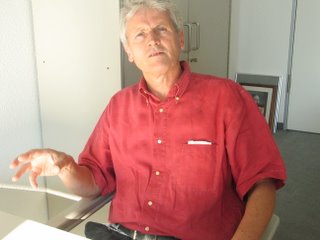
Prof. Joseph McIntyre, lecturer at the department of Afrikanistik and Athiopistik languages, University of Hamburg-Germany, who majored also in Hausa language and has been teaching this for the past 27 years. He told REMMY NWEKE in an interview recently in Hamburg that Internet has made English language more important than any other language in the world.
Excerpts:


AS an Englishman, how did you take interest in teaching Hausa language in an European university, especially when it is realised that it is spoken largely in northern Nigeria?
Yes, I am an English man and now teach Hausa at the University of Hamburg, Germany, which I have been doing for 27 years now. I came here in 1978, between 1974 and 1978 I lived in Nigeria. In Kano within the old city walls. Before going to Nigeria I had learnt Hausa in School of Orient African Studies in London, so that is where I learnt Hausa.
Why did you learn Hausa?
People often ask me the same question, why did you learn Hausa? Well, it is a bit long story, although I was interested in Africa when I went to the university, so I decided to learn African language and social anthropology. So I did my first degree and went to Nigeria in 1974, lived in Kano and did research for one year and then I taught in Bayero University for three years, afterwards, I taught Sociology of Education and African Social System, then I was offered a job in Hamburg to teach Hausa language and I have been here since 1978. I learnt how to speak Hausa in Kano and I learnt Hausa as a student but in Kano I had to speak Hausa. If I had stayed in England, I may have never spoken Hausa.
You have been in Germany for about 27 years now teaching Hausa, how have you been coping?
Let me say one thing about myself, I have continued to speak Hausa because I have always maintained contacts with my friends and neighbours in Gwagwalada and Kurumaya in Kano and also at the university in Kano. Sometimes I telephone and sometimes a friend calls. I also worked at the German radio in the Hausa service because they have some Hausa speaking residents here in Germany.
In 1982, I started to interpret German and Hausa in court in Germany and I did that for about 10 years, after which an Hausa speaker took over the interpretation. Mainly for people seeking political asylum and in early 90s I handed over to an Hausa speaker from Ghana. Since I stopped the interpretation in Hausa, I have some Hausa friends in Hamburg mainly from Ghana, sometimes from Burkina Faso and sometimes from Togo. No Hausa people here from Nigeria or Niger, but mostly Ghana, Togo and Burkina Faso.
Between the time you started teaching Hausa here in the university and now, how many students have passed through this department?
When I started, I inherited 200 persons, these people are taught the same languages all over the university and later you would get, may be 150 or 152 who also would later major on some specific languages, English or French and so on. So after one year it would drop to about 24 and afterwards may be 20 or 12.
What really causes the non-reliability of the number of students in the languages?
I think many students usually start from almost all the courses, because we teach English, Amharic, Hausa and several other languages. Amharic is Ethiopia official language but midway some of the students would go to do something else. We have a good number that have done their Masters and PhD here on languages. Here also we do Hausa and Swahili languages because usually people have to study at least three major languages. So many people would like to study two, Hausa and Swahili, then do their Masters, PhD and leave. If it is possible they leave the languages one side and do Masters in Linguistics or both.
What we basically teach here are African languages, which are the main thrust of our department. Out of the three main languages, for instance, they can learn two.
We also have former students teaching some of the languages, like Voloh, Senegalise language and Nadiga in Gambia. So they have those options even though they don’t study them longer. But the main focus of ours is linguistics.
Most of the times, when they are studying here, some would say I want to write my masters on this subject, this is because at the same time they are studying African languages they are studying Sociology and even Mathematics. Somebody may be studying specialised courses like chronology, that is, sounds of language and comes along to say that he wants to study one African language.
There are many, who come with very different reasons why they come to study, so it is not necessarily that they come to learn Hausa and then decided to do Masters in Hausa or PhD in Hausa. In this case, they would have Hausa as part of their studies, they would also have Swahili as part of their studies, but there are many reasons why they come.
All this while teaching in Hamburg, do you see Nigerians coming to study Hausa language?
I have some African students coming to study, I think from Zaire, Togolese, Benin and yes I had an Igbo girl who came to study Hausa but she did her thesis on Igbo language and since she was a student here, she has to learn a bit of Hausa, a bit of Swahili but she did her doctorate on Igbo.
What is the scale used in determining the choice of languages taught in an institution like University of Hamburg?
Basically it is the size of the language. Swahili in East Africa and Hausa in West Africa are spoken by many people. Swahili for instance is spoken by people at the coast of East Africa from Kenya to Tanzania down to Zanzibar. Swahili was used by the German and British colonialists respectively and it spread in these areas very quickly. It spread from the East African coast and is now being spoken in Zaire as a second language.
Hausa is spoken of course in northern Nigeria. Many of them have been traders across many centuries and most part of Africa about 300 years ago was criss-crossed by trade routes. The Hausa was very predominant in West and North Africa and even maybe across the east Africa, at least, they have contact with East Africa. There is contact between the East Africa and Hausa. Hausa was active in coastal trade and of course when you trade you take your language with you.
Another thing for the Hausa was that about 400 years ago, the first set of traders became Muslims and this has increased dramatically. This is why you have well over 99 per cent of Hausa speakers in Nigeria as Muslims.
Is it possible to have some other major languages like the Igbo and Yoruba spoken in Nigeria as courses here?
There was a Nigerian professor of Yoruba language, who was here for a year, in fact, he is a foremost linguist in Africa, but we have not had any other from Nigeria apart from the student that did her thesis in Igbo language. We had a number of students who write on their own languages. We have German former student, she worked her PhD in Gonia, it is a language related to the Hausa and spoken in some parts of Jos, Plateau State in Nigeria. She wrote her PhD on this language and is now writing on the grammar of the language.
Hausa, Swahili and Ethiopian Amheric were the main widely spoken languages in Africa. I think if the university has more money we would have languages like Yoruba, Igbo, Tiv, Efik, Wolof and so many languages in East Africa. We have other languages too, but Hausa, Swahili and Amheric are the main languages for now.
Do you see your students going beyond the class rooms when it comes to speaking of these languages?
No. The language itself is learnt by students at a certain level. When I started Hausa, precisely on October 24, we would start again. The first semester would be four hours of Hausa each week, second semester would be the beginning of the second year, they would have two hours per week. That means that three hours in the first year, afterwards one and half hours. They would also be doing ethnography, sociology or even politics. So they have to learn a lot but they learn very small amount of these languages to enable them write small sentences, may be letters.
What we do every second year is to organise an intensive course in the various main languages and the best 15 students would go to where their languages are well spoken to live for two months with an indigenous family, to learn how to speak these languages.
Is it for just speaking the languages?
No, they would go for an intensive course and research on how to speak these languages. One student with one family. So if it is in Hausa, an Hausa family with one student and they are expected to speak in the local languages, like Hausa and after two months the language is pretty good.
How do you rate the African languages in that most people on the continent are trying to migrate into speaking foreign languages like English and French and you’re here teaching African languages. Does this mean that these languages are facing extinction locally with less people speaking their own languages?
Educationally there have been a lot of works in African languages; a lot of works in Hausa, Kanuri, down to Ibadan and Igbo and also in Port Harcourt area. These were done by several universities.
Well, to my knowledge, I think the Yorubas are quite active in publishing materials in local languages. They write a lot and publishing in international magazines. Igbos, well used to have a magazine that comes out here twice a year and we get a lot of them. Not so much about the Hausa but we have about Hausa and other related languages, which are what we call chartered languages that are related to Hausa languages.
What could boost the learning and speaking of local languages especially beyond their own domain, like the Igbo Community in Hamburg speaking Igbo here?
Very hard in Europe, but I think in Africa, people are more into other languages. In Europe it would be very difficult, say for the Igbo community in Hamburg to spread the Igbo language here.
But like you said, Hausa is spoken in Germany, is there no way Yoruba could also be of major interest and spoken here too just like the Hausa?
You see, the Hausa is spoken here in Germany by other people. I don’t know the Nigerian community here in Hamburg for instance. The people I know are the Hausa community from Ghana, Burkina Faso and Togo. I don’t know the Nigerian community speaking Hausa in Hamburg. So I couldn’t say if the Igbo, Yoruba are more here that they could do something for the language. So to my knowledge, there is no Hausa speaker from Nigeria.
What of in Berlin?
I think I know one Kanuri speaking man in Berlin.
But what would you say should be a way of promoting local languages?
I can’t really say because we tried to promote it but it was in Hausa, Swahili and Amheric, occasionally we have Yoruba, and Wolof. I think it would be possible if we have more money. There are lots of important languages to teach but it is a question of money. You know, here in our institute, we are smaller group compared to the larger institute. The Japanese and Asian are much bigger than the African studies because they get outside help. I don’t think we can get a lot from Africa, because Germany trades a lot with Japan. China is becoming a major economic power, so there is an economic interest and in Africa this kind of economic interest is not the same. Although there are German companies in Nigeria, there are also German schools in Lagos, but it may be political.
For example, the Europeans, and Americans, they make the money in Africa and take the money out of the reach of Africa. Africa, for instance is rich. Nigeria is an oil-rich country, good quality oil and Angola as well. In Zaire you have gold, Ghana is gold all over. Liberia has diamonds and also in the republic of Congo, that is Zaire again you have cooper and they used to have good mineral that is only used in mobile telephone.
You know, Africa is rich in minerals, is rich in resources, but somehow, it is not Africans that control these resources. African leaders are myopic because African is being milked. Africa is still being exploited by the Europeans, Americans and maybe, the Chinese are coming in now. The flow of money from Africa is quite important to Europe and the flow of goods, raw materials from Africa to Europe and America is quite important, but Africa is still considered poor.
Your country’s president, (Olusegun) Obasanjo, I have heard him say often when journalists ask questions about Nigeria and corruption in Nigeria; corruption all over Africa, we know and why is corruption in Nigeria. Obasanjo after listening to these journalists would always ask, who pays the corrupt politician, who pays the corrupt businessman in Nigeria. And people know they are from Europe and America. So when you talk about corruption being a massive problem in Africa, yes, it is, but not always an African problem because the other people who are helping to cause corruption are in Europe and America; the monies are coming to Europe and going to America.
Rich Nigerians who have lots of money, where do they invest, they don’t invest in Nigeria, they buy houses outside Africa, they send their children to school outside. So the money they have made corruptly does not circulate in Nigeria but circulates in here. Some of them have Swiss bank accounts, German bank accounts, British, America bank accounts.
The money corrupt people have in Nigeria and Africa at large circulates here in Europe and America. Now if all the corrupt people left their monies in Nigeria, for instance, corruption would not be such a problem. It would be a problem but not as big as it is. Because every now and again we hear about corruption here; in German, in England, in France and we are talking about corrupt politicians, and corrupt bank managers.
Corruption is much problem here in Europe and America simply because the corrupt money stays here, and circulates here, so we all benefit from corrupt money.
But for Africa, the corruption doesn’t stay in Africa. So it is only an American or European that can go to bank and say I want to build a house, I want to invest in your industry. Of course the bank manager would agree because he has the money. Why and where do you think the money has come from? If the corrupt money stays in Nigeria and corrupt Nigerians invested in Nigeria and Nigerians have work etcetera, corruption would not be much of a big problem in Nigeria then.
Do you foresee language playing a role in a globalised world in the near future towards reducing corruption?
No. My feeling is that if you put language into the political context, it would be nice if Europe learns more of Africa.
You mean it would be nice?
Yes, it would be a good thing. Europeans on the whole are very, very ignorant of Africa. They know all books, but nothing. They don’t know much of African languages to be honest. If you talk with ordinary German or Englishman and I think it is the same in France. They would say oh yes, African dialect. They use the word dialect. Now any big language has dialect. I come from northern England, we have our dialect. I could say a couple of words to you in my dialect and you would not understand and we all have dialect. Hausa has dialect, but Hausa is a language. Also there is Kano dialect, Sokoto dialect, Ghana dialect. All big languages have dialects. The Igbo language too, sometimes you don’t understand one another because you come from different dialects.
Sometimes, when I speak to some of the top European officials, they would ask, if these African languages have a grammar. Yes, by definition, every language has a grammar; how it is constructed but Chinese is very different from English. And when an intelligent person asks you if these languages have grammar … you must realise that every language has rules. The way it is showing if it is a noun, there is a way it would show if it is pronoun, singular or plural. Some German words have masculine, feminine nouns and neutral. So languages have the same thing and changes both ways too.
But how do you think the role of language in globalisation would help in combating corruption?
Well, in trying to answer your question if language could play a role in reducing corruption. I don’t think so, but I think that learning a language would help or learning about a language would help to reduce ignorance. When people are so ignorant they don’t think they know that. In Africa, there is at least, 1,500 languages and all the major languages have dialects and most cases several dialects. Like in Ghana, there is Ghanaian dialect in Hausa.
If Igbo learn Yoruba and Hausa in schools and Yoruba learn Igbo and Hausa and all Hausas learn Igbo and Yoruba, then people can communicate with each other, but there is need for money to finance this system in schools.
You know, African governments and Nigeria is a very, very good example, having lots of problems; there is a financial problem, there is a political problem. They have advantage now many people speak English and we also have computers, but what do they do with international trade. At least, they know that going to the Internet is no problem, because it is in English.
In other words, would you say that the coming of Information age based on Internet has also added in ‘killing’ local languages?
Well, it made English more important than local languages, more important than it was without the Internet. Internet has given English more power than it has before. It has power before because it is a major international language, probably the biggest language, followed by Spanish and French. The Internet has given English more power which made it harder to solve the problem. Take for instance, if a Nigerian government comes out to say that we want to support our own languages and we choose, Hausa, Yoruba and Igbo because these are the three biggest languages in the country and support these languages, they would still have problems because the financial problems are taught in English language. I once met a Nigerian professor here in Germany, from I think, it was Port Harcourt, who was helping to organise a Nigerian typewriter, which was the best that was before the Internet ….
But with the typewriter keyboards you can still type well on the computer?
That is if you want to type faster and when using a German keyboard, for instance, the vowel letter ‘a’ is at a different place and if you’re using this on a typewriter or computer you would think letter ‘a’ is at the left or right hand.
What do you think is the solution of language with modern technologies?.
I think learning the language is good because you have to learn the culture too. If you learn different languages, you would discover that they have completely very different culture. I am not in favour that everybody should speak English and I would support the development of local languages.
I think the best thing is for everybody in the world to learn a language from completely different culture. It opens secret minds – to realise that people are different and that people see and feel things differently and can express it through the languages. And if we could learn, you would be surprised what you would see. Ah that is why they see it that way and this is what they mean. Very often I still learn, for example in Hausa they say ‘ruwa kudi’ meaning water for money, but now if you understand that, you would know it when they say ‘ruwa’ or ‘kudi’ and how they do say it. And in English, we have the word liquidity or simply liquid meaning cash flow. In other words, there are all kinds of words in our languages and once you see it you would realise it. Like in French they said ‘liquide’. And now if you look at the relationship, in English you said cash flow, what flows, water.
We are all using what we call in linguistics, metaphor and for many years I did not realise that and we even have it in our local language and it means the same thing. So when you learn another language, it opens your mind, especially language from another country.
As at now, the Internet has made English very important and it would be very difficult to promote another language like English on the Internet. Apart from emails, which I like emails in Hausa and people can email in Igbo or Yoruba, it is alright. But to establish website in Hausa, Igbo or Yoruba for the rest of the world to read, I think it would be difficult.
I am totally in support of people learning another language, but as an Igbo, you may wish to consolidate on Igbo language so that people would know and say okay the Igbo they are good at that and they are bad at that. Good at that and not too good at the other thing. If a German knows Igbo, he would definitely know of the Biafran war … laughs.
In Africa, learning of languages is normal but in Europe and America it is not the same.

Wednesday, January 04, 2006

Iranian satellite TV shut

Iranian authorities have shut down the new Saba satellite television channel, launched by the former parliamentary speaker and moderate Hojatolislam Mehdi Karrubi.

The channel, according to the European Journalism Center reports, was ruled illegal by the Tehran government and its director, former MP and film director, Behrouz Afkhami has been summoned to the ministry of intelligence.

Karrubi, one of the challengers of current president Mahmoud Ahmadinejad in the recent elections, had announced immediately after his defeat that he intended to launch a satellite television channel, saying it would be the free voice of the Etermad Melli (National Confidence) party.

Al Larijani, the secretary general of the Superior Council for National Security, who for a decade was head of Iranian state broadcasting, labelled the new channel as anti-constitutional.

Meanwhile, it was also announced weekend that all the films and books which had received the necessary authorisation in the months prior to Ahmadinejad’s election must be re-examined by the ministry of culture and of religion.

Ahmadinejad has given control of this key ministry to one of the symbols of radical Islam, Mohammad Hossein Saffar Harandi, a former editorialist with the conservative daily e Kayhan.

Sunday, January 01, 2006

Economic interests spur foreign languages,

... Nigerians should invest locally

Economic interests have been identified as the most motivator that drives the use of foreign languages in another country globally, just as wealthy Nigerians have been urged to invest locally.

Professor of Afrikanistik and Athiopistik languages at the
University of Hamburg, Germany, Joseph McIntyre, made this observation and call, in an exclusive chat with Business Champion in his office recently.
He said hat in many developing and developed countries respectively that prevalent of foreign languages signifies the level of economic ties or interest with the origin of the language.

Attributing this to the reason why some local African languages are spoken in developed countries of Europe.

Hausa, which is dominantly spoken in the northern part of Nigeria, Prof. McIntyre said, became pronounced following the culture of the Hausas to trade around the coastal zones on the continent.

"Hausa is spoken of course in northern Nigeria, many of them have been traders for many centuries and most part of Africa about 300 years ago, was criss-crossed by trade routes," he said.

Prof. McIntye also cited the instance of dominance by Swahili, which
is the core language spoken by people at the coast of East and Southern Africa, such as Kenya, Tanzania down to Zanzibar.

"Swahili was used by the German and British colonialists respectively and it spread in these areas very quickly," the Englishman said.

He further noted that Swahili has spread from the east African coast and is even now spoken as the second official language in Zaire, Democratic Republic of Congo (DRC).

He pointed out that this motivation has propelled the first set of Hausa traders in these areas also become Muslims, dramatically.

"This is why you have well over 99 per cent of Hausa speakers in Nigeria and neighbouring countries as Muslims, he declared.

He enjoined wealthy Nigerians and most especially those who looted the country to strive by reinvesting these loots locally, so as to help in revamping the economy.

"Rich Nigerians who have lots of money, where do they invest; They
don’t invest in Nigeria," he lamented.


Instead, he noted, rich Nigerians would prefer to invest abroad by buying houses, even outside Africa and train their wards outside the nation’s shores.

"So, the money they have made, mostly corruptly, does not circulate in Nigeria but circulates in here (Europe)," he decried.

Stressing that if the corrupt Nigerians invest locally, Nigerians would have work, food etcetera, and "Corruption would not be much of a big topic or problem in Nigeria".