" ITREALMS: 2006-02-19

Thursday, February 23, 2006

ICT and modern diplomacy

Features of the week:

The importance of Information and Communication Technology (ICT) in contemporary diplomacy cannot be over-emphasized at this era, reports REMMY NWEKE.

At this era of 21st century rooted in Information and Communication Technologies (ICTs), a major challenge facing the contemporary diplomatic community globally, is how to adapt to these technologies in their day-to-day activities.

Diplomatic service
Diplomats, according to the second edition of ‘A Dictionary of Diplomacy’ authored by the duo of professors’ emeritus of International Politics and Relations respectively, G.R. Berridge and Alan James, are "person(s) professionally engaged in the craft of diplomacy as members of the diplomatic service.

A diplomat, the experts also said could be either a ‘diplomatic agent’ or ‘official’ at a foreign ministry. Therefore, diplomacy is "the conduct of relations between sovereign states through the medium of officials based at home or abroad".

Diplo’s intervention
Based on the importance States attach to their relations with one another, otherwise known in diplomatic parlance as bilateral relations amidst other international affairs jargon and the need to foster peace as well as development in this era of ICT, Diplo Foundation with offices in Malta and Geneva, Switzerland, came up with a 10-day workshop on ‘ICT and Contemporary Diplomacy’ for members of the diplomatic community, comprising its Postgraduate Diploma candidates selected globally.

Diplo Foundation is a non-profit organization set up by the governments of Malta and Switzerland to assist all countries, especially those with limited resources to participate meaningfully in international relations, and based on multistakeholder approach involving participation of international organizations, civil society, media and other actors in international affairs.

The Foundation focuses on deployment of ICT through education and training programmes, research, conferences and professional publications.

The 10-day workshop held at the Coastline Hotel, Malta, was attended by participants from Libya, Nigeria, Bosnia and Herzegovina, Romania, Malawi, Peru, Namibia, Bahamas, Burkina Faso, Barbados as well as Malta.

Contemporary diplomacy
This involves the use of modern technologies in diplomatic activities, be it exchange of information or negotiations, mostly between sovereign states. Thus the application of technologies from telecommunications down to multimedia, transcends mere communication on telephone to Internet chat and exchange of information in matter of seconds.

For Ambassador Kishan S. Rana, 21st century diplomat should be able to have a good, sound communications and relevant diplomatic reporting abilities, both verbal and written.

Ambassador Rana who also is a senior fellow at Diplo, noted that before the advent of ICT, every international relations begins with verbal communications, but pointed out that nowadays, it begins online via the Internet, even before the initial meeting of the concerns physically.

While advising diplomats to be concise in their writing, they must look out for key words because it pays to have a straightforward writing, at the same time as it all depends on who you are writing for and your audience.

Online negotiation
Director of Diplo Foundation, Dr. Jovan Kurbalija, noted that online negotiation is very important these days, and more often than not for the Least Developing Countries (LDCs). He called on developing countries to press for global acceptance of online negotiations’ mechanism as a successful means of engaging the rest of the world.

He specifically said that online negotiation is basically good for trade among other technical diplomatic issues, thus preferable to be handled online.

He also cautioned that by clicking on ‘Send’ on the Internet via electronic mail (email), means commitment for a diplomat of any State. Explaining further that online negotiation saves cost, hence it does not involve acquiring equipment for videoconference among other multimedia tools, but could simply be achieved by mere exchange of emails.

Security
Dr. Kurbalija, who is a former diplomat with professional and academic background in international law, diplomacy and Information Technology (IT), also advised contemporary diplomats to always ensure they have an IT person on their side with good rapport.

Emphasizing that the technology is there for man to use, but modern diplomats have a duty to convince their leaders and bosses to adapt, just as he noted that computer security is also there to battle with and "The best is to have a good encryption software".

Most of all, what this workshop brought to the fore is that ICT is inevitable tool in contemporary diplomacy, even as it is relevant in every citizens life as in diplomats.

And like Dr. Kurbalija stated, LDCs should optimize ICT not only because it is cost effective, it gives room for exploration of the available human resources at a State’s disposal.

One realization for contemporary diplomacy, as noted by the Maltese Foreign Minister, Dr. Michael Frendo, in his foreword in a book entitled, ‘MultiStakeholders Diplomacy" launched during the workshop is that the "face of traditional diplomacy has changed".

Remmy Nweke bags another Siemens Profile award


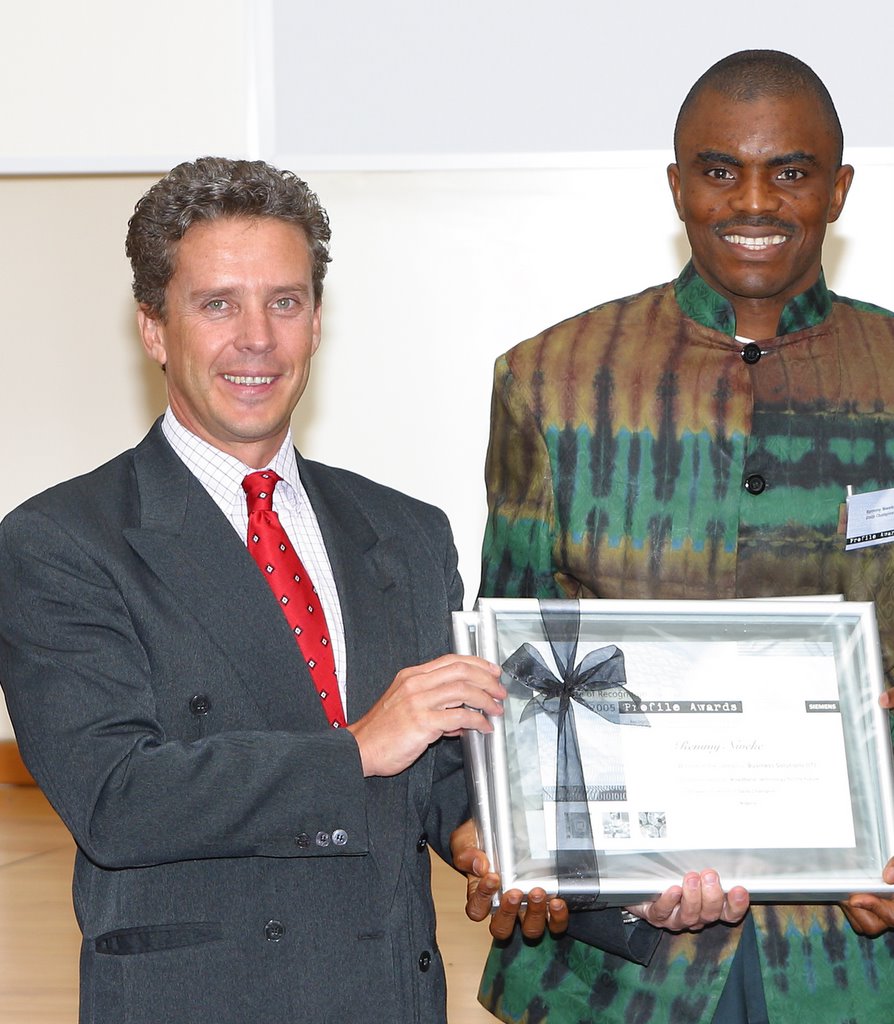
Senior Reporter on Information and Communication Technology (ICT) with Champion Group of Newspapers, and first Nigerian continental Siemens Profile award winner, Mr. Remmy Nweke, has bagged yet another prize at the 2005 African Siemens Profile awards presented in South Africa, Tuesday, February 21 this year.

His prize came in the category of the Information Technology (IT) business solution, making it twice he is winning in this category.

It would be recalled that in 2005, Mr. Nweke was honoured in Midrand, South Africa, at the inaugural African Siemens Profile awards, for journalistic excellence in reporting science and technology in the Information Technology (IT) business solution category for 2004.

Also, he was last year adjudged second prize winner in the Local Content Application category of the annual African Information Society Initiative (AISI) awards, organized by the United Nations Economic Commission for Africa (ECA) under its outreach programme, which lean on promoting Information and Communications Technology (ICT) within the media, since 2003.

Mr. Nweke, who joined Champion Group since 1997 is a pioneer Nigerian journalist to be nominated into the editorial board of the Highway African News Agency (HANA) based in Rhodes University, Grahamstown, South Africa, is also the chairman, International Relations Committee of the Nigeria Internet Group (NIG), member, Justice Development and Peace Commission (JDPC) Archdiocese of Lagos and moderator, African Media ICT4D Nigeria chapter, an off shot of the African Media ICT for Development of AISI, as well as an international member, Canadian Science Writers Association (CSWA), African Science Journalists Association.
In addition, Mr. Nweke who edits ITREALMS Online, http://itrealms.blogspot.com, is a founding member of the Joint Action Committee on ICT Awareness and Development (JACITAD), a non-governmental organization based in Nigeria, Journalists for Regional Integration (JORIN)for promotion of Economic Community of West African States (ECOWAS) among others.

African Siemens Profile Awards organized by the Siemens Southern African office is an initiative that began in 2001 and centered on the Southern African media but was in the 2004 edition expanded to accommodate entries from all nations on the continent, is usually witnessed by over 400 Siemens key customers and partners.

In a letter notifying Mr. Nweke of the prize, the Corporate Media Relations Manager at Siemens Southern African office, Mr. Mandla Mpangese, said "We are pleased to announce that your entry was amongst those short listed in one of the categories".

The Profile Awards, he said, seeks to recognize journalists for their contribution to making issues pertinent to science and technology easily accessible to the people on the ground and is divided into different categories focusing on Siemens core competencies.

"Although it is a Siemens initiative, journalists are not restricted to writing exclusively on Siemens technology," he explained.

In his address at the occasion, Chief executive, Siemens Southern Africa, Mr. Pete da Silva, noted that the 2005 session witnessed high level of interests in the entries, "a volume that has grown substantially year after year".

Pointing out that like everywhere else in the world, science and technology reporting has remained underrated in Africa, of which Profile Awards tends to correct this notion.

Also there were winners from Nigeria, South Africa, Egypt, Kenya including Mr. Isaac Umunna of Africa Today, Nigeria who came top in the Technology Policy and Investment category, Mr. Zachary Ochieng of News From Africa, Mr. Udo Rypstra of Truck and Bus, Ms. Lesley Stones of Business Day South Africa in Fixed Telecommunication Networks, Ms Liz Nganga of The Standard, Kenya in Basic Industry - Manufacturing.

While Mr. Anthony Doman of Popular Mechanics South Africa took the Energy category as well as the overall category among others.

Jonker harps on building fast data center

SYSTEM engineer and HPP Accounts Manager at the American Power Conversion (APC), Mr. Barend Jonker, has outlined how best to build a data center faster by organizations.

Speaking at the recently held fourth ICT for government, which took place in the capital city of Accra in Ghana, he said that organizations could build a data center faster and cheaper, mostly with a higher level of overall available and resilience through looking at the Network Critical Physical Infrastructure (NCPI).

This, Mr. Jonker said incorporates power, cooling, racks and physical structure, security and fire protection, cabling and data centre management.

He declared that today, increasing numbers of companies are centering their strategic initiatives around the perception of standardisation and consolidation.

Stressing that nowhere is this more applicable than in the data center, although he recognized that traditional approach to data centre architecture forces enterprises to build out to full projected capacity from day one.

The outcome, he said, is a long deployment schedule and millions of dollars spent on an under-utilised infrastructure.

As a result of which, it is rarely, if ever, adaptable enough to keep up with today’s changing IT needs, he said.

The accounts manager also pointed out that by taking power protection to the next level, companies are changing the way that data centres are deployed.

In his contribution, country general manager for Africa at APC, Mr. Carl Kleynhans, said that by rightsizing the data centre architecture, "companies would only incur the infrastructure costs actually required at a given time".

According to him, to achieve the theoretically available cost savings, the ideal data centre architecture would only have the power and cooling infrastructure needed at the moment.
"It would only take the space that it needed at the moment and it would only incur service costs on capital infrastructure capacity that was actually being used. It would be perfectly scaleable," he said.

APC which offers a wide variety of products for network-critical physical infrastructure including InfraStruXure, its revolutionary architecture for on-demand data centers, as well as physical threat management products through the company’s NetBotz division.

These products and services, the manager said, help companies increase the availability and reliability of their IT systems.

The aim of ICT for Government (ICT4Gov) is to encourage processes in building capacity within the various arms of government, namely federal, state and local so as to harness ICT for the socio-economic development and improvement of the delivery of public services through eGovernment.

UN creates website for IGF

IN line with expectation of Information and Communication Technology (ICT) stakeholders, the office of the United Nations (UN) Secretary General, has created a website for the Internet Governance Forum (IGF).

Executive Coordinator of the Working Group on Internet Governance (WGIG), Mr. Markus Kummer, revealed this at the international conference on "Internet Governance: The Way Forward" held in Malta recently.

He also said that the WGIG secretariat set up after the first phase of the World Summit on the Information Society (WSIS) held in December 2003 in Geneva is currently listening to the pulse of stakeholders on how best to make the proposed IGF at the second phase, a success.

According to him, UN secretariat has also created an online platform to enable stakeholders post questionnaire to stimulate discussion on IGF.

This online discussion platform, he said, could be found at http://www.intgovforum.org/questionnaire.htm, while the website for IGF is located at http://www.intgovforum.org/.

He called for common understanding on the nature, character and structure of IGF.

Mr. Kummer however, raised some questions for stakeholders, which he said, are pertinent for IGF to truly reflect the multi-stakeholder approach as requested in the Tunis outcome document.

Some of these important questions include what is the forum expected to deliver and what should be the outcome, just as there is need to address the structure of IGF; its format and if it should be an open or closed forum.

Others are how often it should meet, how long should the meeting be, and what kind of procedures should it follow as well as how it should be funded to name a few.

Glo connects Obudu, 34 other towns

Glo mobile in continuation of its avowed tradition, has connected 35 towns in the last four weeks.

Glo Mobile, the Global System for Mobile (GSM) communications arm of the Second National Operator (SNO), Globacom, announced this with the switching on of its Obudu cattle ranch cell sites.

The ranch, a tourist heaven is one of the Africa’s exotic reservation sites for its natural appeal, beauty and wildlife intermingling with modern facilities.

The Obudu Cattle ranch, according to Glo, could now enjoy several services available on the network, including the Multimedia Messaging Service (MMS).

Noteworthy is that Glo Mobile recently connected some parts of Benue State, rolling out in Oju, Anywuogbu, Ochimodi, Ega, and Ogengen, just as in Imo State, the towns of Nkwere and Ideato have now been put on Glo network.

Equally covered in the last one month by Glo include Iju/Itaogbolu in Ondo State, Odekpe in Anambra, Keffi in Nassarawa, Itoikin in Lagos, Omu –Aran in Kwara, Uwana, Afikpo and Amezi in Ebonyi States.

Others are Owode-Yewa, Ago-Ilaro, Oke-Odan, Ilaro and Idiroko in Ogun State, Igbere in Abia, Igbetti, Pariya in Adamawa State and Ogboro in Oyo State.

Meanwhile, another Glo world has opened in Ibadan the capital of Oyo State.

ITRealms Online recalls that in 2003 after its launch, Globacom had opened the first regional office at Challenge, also in Ibadan.

Linkserve upgrades network

Nigeria’s premier Internet Service Provider (ISP), Linkserve Limited, has embarked on an upgrade of its network.

Corporate Affairs and Marketing Manager at Linkserve, Mrs. Ufoma Daro, who disclosed this informed ITREALMS Online that the upgrade is part of the company’s plans to serve "its customers better and to give Nigerians a more pleasurable experience of Internet usage in the country".

The exercise, which includes the upgrade of the firm’s hardware and software would give an added stability to the network and give extra value to customers.

She noted that Linkserve has always been in the forefront of innovativeness in the country’s Internet service market, and said the company demonstrated this when it became the first ISP to introduce Very Small Aperture Terminal (VSAT) technology into the nation’s market.

Linkserve, she said, is again demonstrating its zeal to continue looking beyond most players in the market by upgrading its network.

Mrs. Daro quoted the Chief Executive Officer, Linkserve Limited, Mr. Chima Onyekwere as saying, "This upgrade in software and additional hardware is to ensure that we remain the most stable network in Nigeria and give our customers the best service and value on the bandwidth they have paid for".

Mr. Onyekwere noted that the Linkserve network was the only one that could offer Voice over Internet Protocol (VoIP), amidst competition, describing it as voice service at bandwidths of less than 17kbps.

"Now it is even going to get better, as the new features allow even more saving and improved VoIP deployment," he said.

He underlined the key features of this latest exercise to include leading to customers having more bandwidth for lesser amount of money and optimization of available bandwidth as the sign-on to the hub.

"Customers will pay less for more than 20 per cent improved increase in experience in browsing, which is a major advantage for cyber cafés that use up a lot of bandwidth," Mr. Onyekwere declared.

Wholly owned Nigerian company incorporated in 1996, Linkserve Limited commenced operation in 1997 with an Internet Protocol (IP) connection, offering full Internet services to the public on real time.

Linkserve has coverage in the 36 states of the federation, with offices located in Lagos, Abuja, and Port Harcourt.

Also the company’s coverage has extended to some West African countries such as Cameroon, Ghana and Liberia, with an office in Accra.

Diplo launches research on IPv6

RESEARCH students at the Diplo Foundation based in Malta and Switzerland have launched an Internet Governance project on the Internet Protocol version Six (IPv6), in order to explore more values associated with the version.

IPv6 is the latest version of Internet Protocol created following suspicions by experts in the Information and Communication Technology (ICT), that the current version IPv4 would soon be exhausted.

The research titled "IPv6 and Its allocation" according to members of the project, Messrs Marsha Guthrie, Mwende Njiraini and Jean-Philemon Kissangou, is being conducted as an Internet Governance Capacity Building programme of Diplo Foundation.

The duo of Guthrie and Njiraini who spoke on behalf of the team said, there are three supervisors attached to the project, namely Messrs Andrei Mikheyev, Valentin Katrandzhiev and Vladimi Radunovic, while Director of Diplo, Dr. Jovan Kurbalija, is the chairman of the project.

They also disclosed that the project is in high gear with a good number of the work already in progress.

In the document for comment made available to ITREALMS Online, they noted that implementation of IPv6, has for sometimes now dominated discussions in the industry globally.

Pointing out that increasingly, countries are being told of the many benefits of switching from the older version of IP, that is IPv4 to IPv6.

The essence of this, they said, is that IPv4, is simply not suitable for all of the web-enabled devices currently being used.

They also noted that argument is rift over the adoption of IPv6, on the belief that it would widen the digital divide.

This, the research said, is also at the forefront of the debate on this inevitable transition.

They further said that their research seek to highlight various aspects of the perceived deficiencies of IPv4 by providing a more comprehensive view of both sides of the debate for and against IPv6.

Tuesday, February 21, 2006

ICT youth, HBF team up on ‘Nigeria Rock’

Nigerian youth for Information and Communication Technologies (ICTs) led by the nation’s first Information Technology (IT) Youth Ambassador, Mr. Gbenga Sesan, has concluded plans in collaboration with Heinrich Boll Foundation (HBF) office in the country to launch the ‘Nigeria Rock" project on Wednesday, February 22.

The project encompassing a book, "Global Process, Local Reality: Nigerian Youth Lead Action in the Information Society," and Nigeria Rocks’ documentary.

According to Mr. Sesan, the Nigeria Rocks document is a progress report of Nigerian Youth and ICTs, mostly during the World Summit on the Information Society (WSIS) processes.

He also disclosed that the current IT youth envoy, Mr. Edward Popoola would deliver the report at the event scheduled for Wednesday at HBF office in Ikoyi-Lagos.

Equally on the project’s agenda is the launch of the Nigerian Youth ICT4D Network Portal.

The launch, Mr. Sesan who also is the Project Manager, Lagos Digital Village, noted that these series of events have been lined up to lend credence to the process of youth inclusion and participation in the nation’s ICT for development sphere, as well as they plan to work on the sustainability of these contributions by the youth.

Recalling that WSIS ended in Tunis last December, but it would result to what he described as "Obvious waste of resources, including time and travel money, if any nation or people fail to maximize the opportunities that the process provided and still provides".

He stressed that with the follow-up meetings and continued consultation globally, "it is important for Nigeria to also consider these opportunities".

He underscored the point that as part of their contribution, Nigerian youth on ICT with the support of HBF came up with a book and a 20-minute documentary of their involvement in the WSIS processes, chronicling the efforts of their activities on ICT development in the country.