" ITREALMS: 2005-11-20

Thursday, November 24, 2005

United by digital divide

Features of the week:

Indications are rift that African initiative, the Digital Solidarity Fund (DSF) is increasingly gaining global attention, moreso, uniting the Least Developing Countries (LDCs), reports Remmy Nweke.


On March 14, 2005, when the Digital Solidarity Fund (DSF) was formally launched by the President of the federal republic of Nigeria, Chief Olusegun Obasanjo, in his capacity as the chairman of the African Union (AU), many were assertions in support and against the initiative.


With successful end of the second phase of the World Summit on the
Information Society (WSIS-2005) in Tunisia, weekend, indications showed its attracting more support, especially from developing countries of the world.

What this single step of the launch signified was that more political interest have been clamouring for support of this African initiative, which was proclaimed by the Senegalese President, Abdoulaye Wade at the first phase of WSIS.

The desire to see a new Information and Communication Technologies (ICTs) order within the New Partnership for Development in Africa (NEPAD) was the obvious spirit behind the proclamation.

Partnership that works

At the end of the first phase of WSIS held in Geneva between December 10 and 12, 2003 the initiative committee was formed and made up of the President of Senegal himself, the Mayor of Geneva, Mr. Christian Ferrazino, the Mayor of Lyon, Mr. Gerard Collomb, and the president of the Province of Torino, and member of European Parliament, Ms Mercedes Bresso.

Borne out of the aspiration to advance this emerging technologies beyond developed countries and to ensure that truly new society based on Information Society (IS) takes root in the Least Developed Countries (LDCs) like in Africa by transforming the public and private sectors while creating a new social, political, economic and cultural opportunities worldwide.

Projections are that this digital revolution if not well checked, will leave out millions of men and women, otherwise described as the ‘info poor’ behind, thus excluding great majority of those residing in developing countries as well as in rural areas.

All inclusive society

According to the DSF secretariat, economic sociological studies have shown that in many countries, the digital divide represents a factor of exclusion from global exchange processes, in essence restricting the development of intellectual capital and slowing down economic growth.

It also described digital divide as dangerously increasing the lack of understanding between cultures and civilizations. The United Nations Development Programme (UNDP) reports on the failings of technological changes to empower the developing world, warned against ever-growing disparities between affluent nations and those lacking basic skills, resources, and infrastructure.

Most of the world’s population lacks basic access to a telephone line, let alone to a computer, while entire societies are marginalised at the periphery of communication networks.


And in the bid to abridge the growth of digital disparities between
and within countries, the declarations of intent obviously made at the first phase was reportedly not enough, hence the endorsement of Plan of Action.
Therefore urgent action, is needed to respond to the shortage of basic equipment; investment in computer literacy and extending the reach of information flows represented in immense undertaking as well as core collaboration among stakeholders through a solidarity effort between cities, regions, states, civil society and the private sector.

However, as a move to complement existing national international financial resources, the creation of a world Digital Solidarity Fund based on voluntary contributions and operating in prompt and transparent manner becomes an appropriate response to the uneven distribution and use of ICTs.

The mission of the fund according to DSF secretariat would be to promote and finance development projects that will enable ‘excluded’ people and countries to return to the center stage of information society.

Support

In recent past, supports have come from some 20 members including government, regional organisations, cities and localities as well as international agencies through the African Union (AU) at the summit of African Heads of States held at Addis Ababa, July 2004 among others.

Currently, the foundation board comprises about 33 members with 15 to 20 others co-opted for a period of three years term. They come in equal numbers from three colleges in a tripartite representation.

Benefit

In order to benefit from DSF, candidates basically by countries would be selected on criterion set aside by the DSF secretariat, which consist of 60 per cent of its resources to be channeled on populations of least developed countries.

Also, 30 per cent of the total resources would be targeted at populations of developing countries and 10 per cent serving the nations in transition.

On the other hand, projects eligible to benefit particularly from DSF must be aimed at developing the good use of ICTs within communities ‘excluded’ from the development of ICT networks; while priority must be on women’s associations, youth or groups with specific needs such as people with disabilities, indigenous people, among others.

Gaining status

By the time WSIS ended Friday, November 18 in Tunis, DSF has gained more status of support with prominent among them being Nigeria’s redemption of its pledge of 500,000 Euros (about N76,380,882.16), to the initiative, and promised to provide office spaces for its African regional headquarters to be sited in Abuja, the nation’s capital.

President of Global DSF, Mr. Guy-Olivier Segond, was full of praises for supporting countries like Nigeria, Senegal, Cities of Lyon and Geneva as well as Dominican Republic, who was represented by the first lady of the country, Mrs. Margarita Cedeno de Fernandez.

Most interesting at the DSF function during WSIS-05, was the
electronically wrapping of Senegal’s official data in a 2.0 Universal Serial Bus (USB) with her national colours deep green-yellow-red.
Definitely the African initiative is not only gaining global attention but is gradually rejuvenating the way development responses should be made to the developing countries, especially using ICTs.

Nigerian youth wins WSIS award

Eighteen years old Nigerian, Samuel Oloyede Odofin, has emerged the second prize winner for the development category of the World Summit Youth Award (WSYA) held as part of the second phase of the World Summit on the Information Society WSIS-05 in Tunis.

His emergence was based on the entry, Biotechnology: The
Food solution (www.odofin.com).

The campaign he started three years ago, had earlier grabbed awards such as the Microsoft unlimited potential motandao Afrika Internet challenge, resource site awards, golden web award and the cable and wireless childnet academy awards.

The project which was described as an interactive website designed according to the award organisers, was to raise awareness on the use of agricultural biotechnology in combating food shortages and insecurity in Africa.

Managed from the city of Kaduna in northern Nigeria, Odofin’s project scaled through amidst 299 others from over 70 countries of the world.

Speaking to Champion Infotel afterwards, Odofin said he was honoured when the information came that he won the award, which he saw as a privilege and opportunity.

"I felt extremely honored when I was informed that I was one of the
best multimedia developers in the world. I looked at it first as a privilege and secondly as an opportunity to tell the world that good things still comes out of the slum," he asserted.
Award organisers, the International Centre for New Media (ICNM), said that the exercise was put in place to inspire internet content from innovative youth of the world.

Project manager of ICNM, Mr. Thomas Biebl, disclosed that the award has availed them the opportunity to see online music communities, digital design training for slum youth, interactive gaming platforms e-learning flash applications and an HIV/AIDS information portal to name just a few.

The top three projects, he explained, in each WSYA category were focused on development, creativity and culture as well as community engagement.
He stressed, it is a global initiative to select and promote the world’s best in e-Content and creativity.

Nine firms partner InterSwitch on POS, issues 1.2m debit cards

LEADING electronic trans- action switching and payments processing company, InterSwitch Limited has named nine local companies as partners for the deployment of electronic fund transfer at the Point-of-Sale (POS).

Managing Director of InterSwitch, Mr.. Mitchell Elegbe said, those
who made the list were respondents to its recent advertorial for application on Independent Service Organisation (ISOs).


He gave the names of the nine companies to include Caplink, Capital Partners Financial Products, Ecco Solutions, Electronics Playplus, ETopNG, Paycycle, PayMaster, PayStream and SWAP.

The appointment, he said, was in line to drive the nation into a cash-less society.
"Of the 13 companies hat applied, nine of them have fully met all the requirements," he said.

The appointees, Mr. Elegbe said, are now fully certified ISOs, noting that they would work in consonance with acquiring banks on the InterSwitch network in deploying online POS terminals to all merchant locations where payments are made and received.

He explained that they would also train the merchant’s employees on the use of the POS terminal and other support services as may be required from time to time.

InterSwitch boss further said that his firm would carry out transactions routing and processing in addition to effective reporting and settlement to all transacting parties and provide call center/helpdesk support as well as status information on all the terminals connected to the switch.

Mr. Elegbe said that by partnering these ISOs is to add value to
merchants via the deployment of the POS terminals is in the spirit of National Economic Empowerment and Development Strategy (NEEDS).

His firm’s strength, he said, resides in transaction switching and payment processing, just as the company has abundance mentality as far as electronic payment is concerned, which has influenced its partnering with organisations like ATMC Limited and the banks for ATM deployment.

According to him, in the last 10 months, InterSwitch has achieved substantial growth, integrating 33 banks while successfully working to expand the payment channels on its network.

This facilitated the real-time issuance of 1.2 million Nigeria debit cards on its network.
"Over 1,561,109 individual transactions have been processed by the network," he declared.

Emphasising that it is an indication Nigerians are beginning to respond favourably to basic electronic financial transactions.

SIMS dangles incentive on Samsung dealers

MAJOR distributor of Samsung Electronics product in the country, SIMS Nigeria Limited, would soon introduce new packages for its dealers nationwide.

SIM said the incentives would form part of the 2006 marketing strategy according to the chairman, Chief Simeon Eyisi.

He revealed this in an address to the SIMS and Samsung’s dealers nite held Monday in Lagos.

He expressed thanks for the support SIMS has enjoyed from its
dealers nationwide, and enjoined them to continue in that stead for joint growth of all the parties, and the national economy.

SIMS, he said, would contract them individually to discuss the details of the new incentive to come.

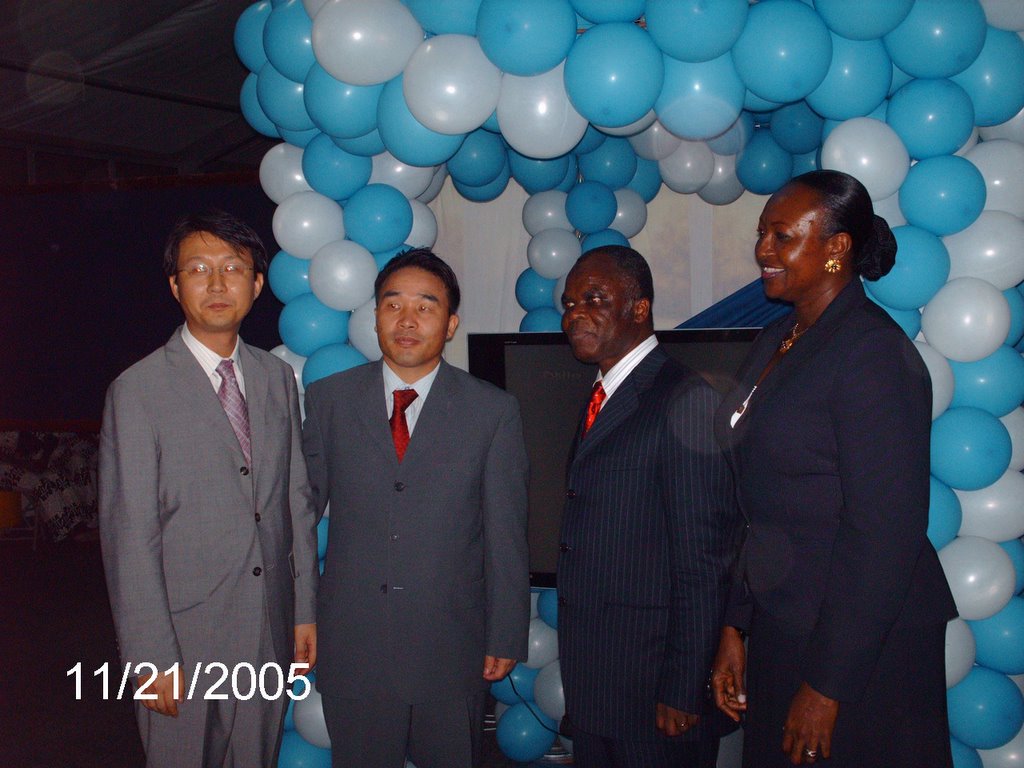
Also speaking, country Managing Director for Samsung, Mr. James You, who was accompanied by the Manager, CDM Trading Coy Limited based in Korea, Mr. Y.M. Lee, said, he was proud of Samsung’s in roads in the nation’s market.

He appealed to the dealers to be consistent on their patronage of Samsung Electronics products, saying by that way, they would also break even.

To further facilitate this and importance of the Nigeria market
paved the way for setting up the country office in Lagos, he said.

Manager, Home Appliance at Samsung Nigeria, Mr. Yomi Lawal, said the firm’s new television set soon to be available in the market has a better and higher resolution against the Plasma Digital Product (PDP).

He gave the name of the new product as Digital Light Process (DLP) and enjoined dealers to tap into as it's better than PDP products.

Other guest at the dealers nite include Barrister (Mrs) B. Eyisi, wife of SIMS’ chairman, and Manager, Audio Visual and Information Technology (IT) at Samsung Nigeria, Mr. Chidiebere Nworgu, as well as Mr. Endy Nwogu of SIMS among others.

Nokia, Grameen collaborate for African villages

Mobile telecommunication giant, Nokia, and United States-based Grameen Foundation have announced collaboration at the just ended second phase of the World Summit on the Information Society (WSIS-05) in Tunisia for empowering rural African villages.

Michelle Tennant of Grameen, informed that the partnership would bring about affordable, accessible telecommunications to rural villages on the continent through micro-financing, built on the GF’s global village phone initiative, which helps rural people to start self-sustaining businesses.

"Access to affordable and reliable telecommunications services are
life line for rural communities and a critical part of overall
development,"
Tennant, who is media contact for foundation said.

Pointing out though that the costs of mobile phones and services have fallen significantly, the initial investment needed to get connected remains one of the most valuable huddles to expanding communication services in these areas.

"By providing the necessary cash, micro-finance has proven to be a powerful tool in overcoming this barrier. With tiny loans, financial services and mobile technology, village phone provides affordable access in a sustainable manner," Tennant explained.

According to the GF official, the collaboration between the two was designed to accelerate efforts to make universal access, particularly in rural areas of Africa a reality.

Stressing that as part of this effort, Nokia and GFUSA jointly
developed a solution based on Nokia’s most affordable phones and an external antenna to serve rural communities in Uganda and Rwanda.

Tennant also quoted the Director, Business Development and Industry Marketing at Nokia’s Entry Business Unit, Mr. Antonio Torres as saying that a mile stone was achieved last September with the achievement of two billion mobile subscriptions in some rural areas.

"Rural connectivity will play a major role in reaching the next billion subscribers and ultimately connecting half the world. Nokia is proud to collaborate with GFUSA on this significant initiative," Torres said.

Omatek, proudly Nigerian @ WSIS-05


Interview:

Omatek Computers Limited was the only Nigerian ICT company that showcased at the just concluded World Summit on the Information Society (WSIS-05) held in Tunisia. General Manager, Yomi Soyinka explains in a chat with REMMY NWEKE, why Omatek is proudly a Nigerian company.

Tell us briefly about your company?
Omatek Computers Limited is assemblers and manufacturers of computer hardware and home entertainment products in Nigeria.

So what are you doing in Tunis?
We are here as part of the Nigerian delegation to showcase our products to the whole world and it is part of our resume in letting the world know and how far we have gone in the Information and Communications Technology (ICT) wise.

Are you getting the right response?
Yes, we are getting very good response from delegates from other countries attending this summit.

What is your message to other companies in Nigeria who are not here?
First of all, my message is to the government of Nigeria to continuously create an enabling environment for companies like ours to come up and like us who are aspiring to come up to the level that is obtainable in the advancing countries.

They should endeavour to ensure that they do it with all vigour and sense of purpose, so that Nigeria can get to a stage whereby we would be able to turn our products to the rest of the world and maybe rank side by side with foreign products that are notable for their genuineness and durability.

Specifically, what are your words for companies like Omatek but exist in Nigeria, what advice do you have for them?
Well, they should come up like the way we are trying to do too in the area of ingenuity, product compatibility when it comes to foreign brands and they should be able to sit down and work out ways of how to run side by side with products that are well known in the world.

Nigeria restrategises IT policy for implementation - Olatunji

Interview:

Please could you tell us what exactly is happening here at the Nigerian Pavilion?

Yes and thank you very much. You know that we in Nigeria have an Information Technology (IT) policy which my organization, the National Information Technology Development Agency (NITDA) is implementing. And what we are trying to do is to work closely with all stakeholders in the area of ICT development in Nigeria.

On this WSIS, we have been in close collaboration with the Ministry of Communications and we have a national committee on WSIS.

What you are seeing here is what we are trying to showcase as part of what is happening in this area of ICT and that is what we are telling the whole world at WSIS.

What do you think of the entire WSIS process up till this stage?

Like I was discussing with somebody yesterday, I said that the WSIS process is really worth it, especially for the developing world, but we should not stop at this summit alone at the discussion level.

The main thing we can say we are taking away from the summit is implementation. If we are able to implement and catch up with the rest of the world, that is when we can yes, it has really been successful.

So, how ready would you say that Nigeria is as far as the implementation is concerned?

As you know, the issue of ICT involves all stakeholders, but the most important thing when we get back home is that NITDA being the main driver of IT policy implementation in Nigeria, would need to get all stakeholders together and to know who does what.

We would also allocate duties to every organization among the stakeholders, both those in the private sector and public sector as well.

I am sure that by the time we complete this phase, every body would now have a role to play and be involved, because it is not what the government alone cannot do and it is not what NITDA can do alone either. All of us have to join hands and do it together.

Do you think that the private sector is cooperating?

I think it depends on what you mean by that. For instance, if you really look at IT development in Nigeria before NITDA came onboard; the private sector has been there and very active too.

What we are to do in government is just to facilitate and to act as catalyst to whatever we want to do. May be in terms of policy issues, saying, these are policy issues we are supposed to put in place to ensure that these people putting their money into these things for IT development in Nigeria and they have been cooperative so far.

So, you are positive about implementation of whatever comes out of WSIS-05 in Nigeria?

I am very, very positive that we are going to gain a lot from this WSIS process in Nigeria as a country.

How many Nigerian companies are with you in this Pavilion?

Well, there is only one say company from Nigeria, because what we are trying to do is that for instance, in the area of IT, we have about five companies’ assembling IT equipment in Nigeria and they are not coming here per say to sell, but to say yes, this is doable and possible in Nigeria.

So this company is representing the other companies in Nigeria and if you are saying this Omatek, it is this and that in Nigeria; we have four other companies that are doing the same thing.

That is the main thing and not the number of people that you are bringing to the exhibition or WSIS, but simply to say that we have a stand and we are telling the world what we are doing down in Nigeria.