" ITREALMS: 2006-06-25

Wednesday, June 28, 2006

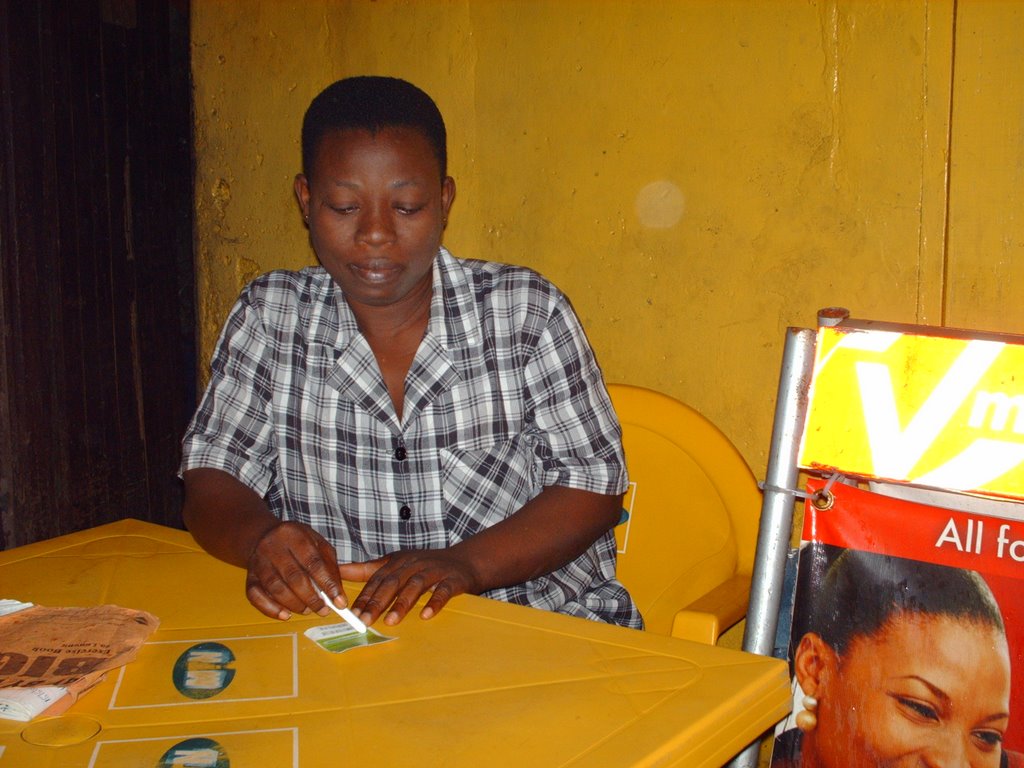
Chalk, perfect solution for scratching cards


Features of the week:

Over the years, Nigerian telecom subscribers have picked quarrel with sellers of recharge cards because of one reason or another. Most among them has been over scratched off Personal Identification Numbers (PINs) on the card. REMMY NWEKE reports that chalk has come to the rescue.

PENULTIMATE Wednesday at Ali Street, Tinubu Square, Lagos Island in Lagos, there was a commotion; crowd gathered with voices being raised almost at the same time.

Inquiries by our correspondent revealed that one of the traders in the neighbourhood, Mr. Ade Tunde, was at the centre of the commotion. The contention was that he bought a recharge card from one of the Commercial Telephone Operators (CTOs) along the street and eventually scratched off the PIN in the evening of the previous day.

Next day, it was reported that he returned to the CTO being manned by a female school-leaver also known as ‘umbrella people,’ claiming damages that the recharge card of N1,500, was fake.

An argument ensued leading, however, to some male neighbours of the CTO intervening. This culminated into a fight, leaving in its trail some broken bottles, heads and of course, blood flowed.

Further inquiry showed that the recharge card was duly bought by the CTO from one of the major dealers of the Global System for Mobile Communications (GSM) operators in the country.

Parliament episode

Also in recent times, there has been no session in the monthly Telecoms Consumers Parliament without a subscriber complaining of scratching off the PIN of his or her recharge cards across the networks. If it is not a subscriber of GSM operators it would be that of Private Telephone Operators (PTOs).

The parliament is organised monthly by the Consumer Affairs Bureau of the Nigerian Communications Commission (NCC) as an avenue for interaction between industry operators and consumers, which is held in the six geo-political zones of the country.

These complaints heightened since 2005, following the approval granted to 14 companies to produce degradable recharge cards locally to be used by the teeming telecom subscribers, nationwide.

It also follows the announcement by President Olusegun Obasanjo, at the end of a meeting with telcos at Presidential Villa, Abuja on May 2004, where he disclosed the intention of the government to ban the importation of recharge cards into Nigeria with effect from 1st January 2005.


Upholding Presidential directive

With the Presidential directive, the Minister of Communications, Chief Cornelius Adebayo wasted no time in summoning stakeholders to a meeting in his office to further fine-tune the decision and to ensure prompt implementation of the policy.

At that meeting, the major operating companies commonly affirmed the possibility of manufacturing all their recharge cards requirements locally.

According to the Minister, this process must not be a “free-for-all process but that the companies to be approved for this project must be credible and possess the expertise to ensure that they can meet the requirements of the operating companies and the objectives of government.”

He noted that government was conscious of the fact that if left uncontrolled, the nefarious actions of some unscrupulous elements may frustrate the good intentions of government.

At this end, Chief Adebayo detailed NCC, to initiate a process of selecting qualified companies to be issued permits to manufacture recharge cards in Nigeria.

And by way of advertisement in the media, NCC proceeded to invite expressions of interest from interested companies for the manufacture of recharge cards locally.

A total of 98 companies responded to the advertisement and through screening of the applications, it was observed that over 60 per cent of the applicants were mere speculators who hardly had any clue about the exact requirements of the business being applied for.

The screening exercise resulted in a shortlist of 27 companies based on the information contained in their submissions.

These companies were then required to collect application forms and provide detailed information about their business plans, experience and financial capability among other facts.

As at Monday, August 9, 2004, only two of the invited 27 companies did not respond therefore a total submissions of 25 fully completed applications were received, evaluated and ranked in accordance with the completeness and relevance of the information supplied in response to the requirements outlined in the application forms.

After the summary of the submission presented to the Minister, he in turn approved 14 companies to be issued permits to manufacture recharge cards in Nigeria.

14 wise firms

The successful 14 companies granted permit by NCC to manufacture telecom recharge cards include the Security Printing and Allied Solutions (SPAS), Masterstroke Packages Limited, Airtel, Nitecrest, Cards Technology Limited, Namitech West African Limited, Snecou Group of Companies, South Beach Company Limited (SBC), Controcards Limited, Advantel Limited, PremiumIdeas Limited, Hemnung Investment Limited, Alfa Juliet Mangler Limited, and Orga Kartensysteme Limited trading as Orga West Africa.

However, it was emphasised that these permits were not a once-and-for-all process, as government would closely monitor the performance of these companies that have been granted the first batch of permits as well as the supply-demand equilibrium. Even as further permits may be granted in due course in response to the dynamics of the market, and decision of government.

Hitherto

Before now, CTOs have fought with customers over over-scratching of recharge cards owing to the grazing off of the PIN numbers which is the most important thing on a top-up card, just as was witnessed recently at Tinubu square.

Initially, Nigerians have used the ‘Bic-cover,’ which works out in two ways, by way of scratching well at times and often taking along with the scratch-off the numbers. Also some susbscribers use sand to wipe the surface of the silver column.

There have been cases whereby subscribers have to use hard objects to scratch off these recharge cards because the silver coating on the PIN secret column was heavy.

Then came the era of cleaning the silver column with just a scratch which received an outcry from the members of the public especially consumer protection agencies with special focus on telecom consumers.

On the other hand, some of the cards were being scratched beyond recognition by some subscribers, most of who are in the prepaid or what is called in local parlance ‘Pay As You Go’; who are often in a haste to scratch, load and begin to make calls immediately.

This means subscribers only buy cards when they needed to make calls, and in that haste get the card damaged. This, over the last five years, must have accumulated into several thousands of Naira, and automatically written off by subscribers or the sellers, which in this case are the CTOs, as bad debt in most cases.

And in order to retrieve such scratched off numbers subscribers have to call customer care of the telco in use, which experience is subject for another day, because often they would simply confirm that the phone is yours and request you to provide the batch and serial number of the recharge card as well as part of the PIN still visible, with which to assist the affected subscriber. This takes at least 24 hours to accomplish.

Chalk, a saving grace

However, in the spirit of dynamism in the nation’s telecom market, Nigerians, especially the CTOs, have discovered another method of scratching recharge cards without any blemish.

Investigations by our correspondent showed that this method of scratching off the silver coated column in most recharge cards could be achieved with a piece of chalk.

Chalk, as defined by Longman Contemporary dictionary, is a soft white or grey coloured rock formed a long time ago, from the shells of small sea animals, and nowadays used extensively in writing on a blackboard.

Just place your piece of chalk on top of the silver column and move forward and back and by the time you do that up to five times, the PIN numbers would begin to surface without any damage to the numbers, or the card.

Confirming this to our correspondent, a CTO Ms Felicia Ike, who is located at Oshodi, a Lagos suburb, said that nowadays, they sell their recharge cards without any headaches or heart-attacks even as she demonstrated how it works for us to see. According to her, seeing does not only make you believe but convinces you further. She described it as “scratching without tears.”

Although there is palpable fears among CTOs that as this ‘secret’ of scratching recharge cards has been revealed the price of chalk in the market may go up beyond the several pieces they now sell at N10.

Caution

Ms Ike, further advised subscribers to stop recharging only on emergency or when they are already tensed up on a subject, “because that is when most of the recharge cards develop problems due to the force used in the scratching exercise.”

Additionally, “it is always good to recharge when you are at peace with oneself, although now the chalk formulae has come, subscribers may decide to close their eyes and still have a clean but not scratched off PIN as long as they placed the piece of chalk at the right place and move back and front.”

On the use of sand to wipe the surface of the silver column, the CTO said it truly works but very dangerous like the application of Bic-cover over the column, stressing that when done mildly, it comes out neat.

She also said that the ultimate result would be scratching your recharge cards without tears, that is, using a piece of chalk. This, she noted, obviously, is another way of finding innovative solution to technology questions in developing country like Nigeria and at the same time adding local value.

ITREALMS Online ... delivering news for ICT4D

Nigeria commences demo on 3G, GSM operators express interest

Remmy Nweke

ALL the five Global System for Mobile Communication (GSM) operators in the country may have applied to the telecommunications regulator, the Nigeria Communications Commission (NCC) for the Third Generation (3G) license, just as Nigeria has commenced trial of the relevant frequencies on that platform.

NCC has also begun investigation of the international prepaid call operators in the country, even as current subscribers may need new handsets in the 3G dispensation.

Third generation promises higher data speeds and thus higher usage of both data transmission and other multimedia transmission.

Executive Vice Chairman (EVC), NCC, Dr. Ernest Ndukwe, gave this indication in a chat with newsmen in Lagos, Wednesday, after delivering a paper at a business luncheon of the Ikeja branch, Nigerian Society of Engineers (NSE).

Dr. Ndukwe who dwelt on “Third Generation Services and Their Potentials for Nigeria” said all the GSM operators expressed interest in rolling out 3G licenses.

According to him, the operators also asked for demonstration frequencies, which he said, have been given to three vendors, namely Huawie, Ericsson and Alcatel.

He said that why the operators were denied demonstration frequencies was to avoid temptation of their going headlong in rolling out the services.

The demonstration, he also said, would last for three months after which the outcome would be evaluated to know if extension is necessary.

Dr. Ndukwe, further expressed optimism that GSM operators have the chance of getting 3G license and NCC has not actually developed the modalities as to the licensing.

The commission, he said, is currently investigating international prepaid operators in the country.

Ndukwe, who described 3G as a farther enhancement of telecommunications services to Second Generation (2G) and enhanced 2G which is 2.5, said it enables the user to transmit and receive voice, data, and picture signals simultaneously on portable mobile phone while in motion.

Otherwise referred to as triple play or quadruple play when Internet is incorporated, he pointed out that the relative speed of the user with respect to the base station or source of transmission, affects the data rate at a given quality of service.

On the service point of view, Dr. Ndukwe said, 3G provides toll quality telephone service, compact disc quality music, picture and video offering, internet access and location based services as well as high end games in addition to electronic commerce with rich content.

Stressing that 3G services consume a lot of bandwidth and generate high data rates.

“A 3G video service, for example, generates over 500 kilobits per second (kps) data rates compared with 13 kps generated by a GSM user,” he declared.

Eventually if 3G takes off in the country, new subscribers to the platform, he said, would require new handsets since most present handsets being used are not usable with 3G.

“The operating environment also needs to be prepared for the network resources that 3G services would demand,” he said, noting that presently, the GSM 2.0G/2.5G networks may have to undergo some technology upgrade to an all Internet Protocol (IP) network for greater efficiency and throughput.

ITREALMS Online ... delivering news for ICT4D

Internet: Lagos Island exchange ready soon

Remmy Nweke

Four months into its life span the Nigerian Internet Exchange Point (NIXP) Implementation Committee, has said that the Lagos Island Internet Exchange Point (LIXP), would by Friday, this week be certified ready for operations and soon to be commissioned by Chief Olusegun Obasanjo.

An Internet Exchange Point is a facility operated by a single entity to facilitate the exchange of Internet traffic between three or more Internet Service Providers (ISPs) according to www.internetpolicy.net.

Presently in the country, local internet traffic is exchanged outside the shores of the nation across several hops with the associated high cost of service delivery which limits internet penetration and local-content distribution.

NIXP is expected to build seven exchanges in phases beginning with main-branch at NECOM House Lagos, and additional two sites at Ikeja and Victoria Island, as contained in its reference during inauguration last April 14, by the Nigerian Communications Commission (NCC).

Other branches include that of Ibadan, Port-Harcourt, Enugu, Abuja, Kano and Maiduguri which cover the six geo-political zones of the country.

The committee led by a seasoned telecom engineer, and chief executive, Amsco Telecom, Mr. Ndukwe Kalu, disclosed to our correspondent, that the first of the IXPs would be completed before the end of work on Friday, June 30, this year.

Mr. Kalu, who also is the Vice President, ISPs Association of Nigeria (ISPAN), said that the next step would be to report back to the government authorities via NCC, while work continues on other exchanges.

In addition, he said, the plans for official commissioning of the Lagos Island exchange would commence afterwards.

He explained that the core merit of the exchanges when completed nationwide are expected to reduce the cost of accessing Internet both for the operators and consumers.

He also revealed that as promised last May during a stakeholders’ forum in Lagos, NIXP has engaged an expert to manage its operational aspect in the name of Mr. Mohammed Rudman, who has been appointed the pioneer Managing Director of NIXP.

Other appointments being expected to be made public soon include the position of the sales and marketing manager as well as the finance manager which are at advanced stage now.

Equally, in the board of NIXP are the chief executive, Medallion Communications Limited, Mr. Ike Nnamani, Chief Business Development Officer at Interconnect Clearing House Nigeria Limited, Mr. Tosin Oni, Head, Content Department, Emperion West Africa, Mr. Femi Adalemo, Deputy General Manager (DGM) Internet Services at the Nigerian Telecommunications Limited (NITEL), Mr. Olayinka T. Abiodun, Assistant Director, Licensing, NCC, Mr. Abubakar Yakubu, and Deputy Manager, Technical Research and Standards NCC, Mr. Chris Agha.

NIXP is seen as a public, private partnership between NCC and ISPAN in achieving the dream of the federal government, while Digitek TeeVee Engineering Co. Limited, manages the implementation of the first phase of the IXP project in Lagos.

ITREALMS Online ... delivering news for ICT4D

Ndukwe lists prospects for ISPs in Unified License regime

Remmy Nweke

Executive Vice Chairman, Nigerian Communications Commission (NCC), Dr. Ernest Ndukwe has said that there are prospects for Internet Service Providers (ISPs) in the country in the recently introduced Unified Licensing Regime (ULR) as well as the coming of the Internet Exchange Points also known as “Internet Gateway”.

Speaking at a one-day seminar organised by the Nigeria Internet Group (NIG) on Internet Service in the UL regime as the guest speaker, he said that anticipation is high including price reduction for various internet access services in the country.

This, he said, would result to higher profit margin for the service providers.

Dr. Ndukwe, represented by Head, Business Development, NCC, Mr. Nnamdi Nwokike, also warned of potential danger in the regime, saying that there are some hiccups for small and medium Internet Service Providers.

Therefore, it will be imperative for them to realign their businesses or possibly think of joining forces in terms of merging in order to be able to compete favourably in the new dispensation.

He also said that they will require a robust network infrastructure and huge capital resources to match the kind of competition that may likely unfold such as the low Personal Computer (PC) penetration in the country which could prove stumbling block for wide internet usage.

He noted that a report according to the Economic Intelligent unit, the stock of personal computer (PC) per 1000 was 11.09 as at the end of 2005. For this reason, low PC penetration remains a big challenge coupled with high level of illiteracy.

Although there is now a growing recognition of the far- reaching impact of telecommunications and information services on the Nigerian economy, the high level of illiteracy still restrict the diffusion of internet. Worst still, even half of those that are literate cannot use the internet for problem solving.

In the Unified Licensing regime, he said, it is expected that there will be growth in Internet access as many players will enter the market. However, as this happens, a major challenge would be in the area of content control.

“The ISPs will need to do a lot of work to ensure that there is a control of access to objectionable content such as adult materials to protect children and vulnerable individuals in the society,” he advocated.

Similarly he said, there is need to ensure that Internet is not used for scams which has in the past years projected Nigeria in bad light in the international community

Internet engineers and technologists, he noted, are still very few in Nigeria relative to the demand. He stressed that the result is that innovations from the home-front are almost non-existent as “we depend on the advanced countries.”

He maintained that no matter what obstacles before ISPs, Internet is central to the new vision of Nigeria to be an IT power in the Sub-Saharan Africa. This, he said, saw to the government’s inauguration of the Nigerian Internet Exchange Point implementation committee recently.

Pointing out that ULR will encourage free growth of new applications and services that will stimulate the development of every sector of the Nigerian telecoms industry.

“There will be substantial improvement in the level of infrastructure required to drive broadband internet penetration,” he asserted. Underscoring that the level of competition in every sector of the telecoms industry, including Internet Service Provision, will deepen with substantial level of investment equally required to be able to compete in the new licensing regime.

He urged ISPs to take advantage of the Internet Exchange Points and Gateway being established in the country by signing to it In order to ensure that the ISPs are not undermined in the scheme of things under the new regime.

“They need to consider merger and coming together. By consolidating, they will enjoy synergy and economies of scale that will put them in good stead to compete favourably and take advantage of the numerous benefits offered by Unified Licensing,” he said.

In his submission, he said expectations are high that the Nigerian Internet market would be sustainable under this regime, considering the strong entrepreneurial culture, advancing local IT industry, both in terms of software and hardware as well as the responsiveness of the regulator.

ITREALMS Online ... delivering news for ICT4D

Solutions abound in current dispensation – Omo-Ettu

Remmy Nweke

With the introduction of the Unified Licensing Regime (ULR) in Nigeria, last March, solutions abound for consumers in the current dispensation, according to the chief executive, The Executive Cyberschuul Lagos, Mr. Titi Omo-Ettu.

Dwelling on the “Consumers expectation in ULR” at a one-day seminar on Internet Service in ULR regime put together by a non-governmental organisation (NGO), Nigeria Internet Group (NIG), Omo-Ettu, who also is a member of the board of trustee of the group, said ULR translates to a one-stop service availability, especially through the internet.

Consumer basic expectations, he said, encompasses availability of solutions, quality of service and low tariff.

As said by him, ULR begets into the sector availability of television, radio, telephone over the internet and brings a stop to duplication of subscriptions and the need to carry multiple telecommunications terminals about.

For Nigeria as a nation, he said ULR has the potential to leapfrog the economy by catching up with other lands in provision of popular and premium services despite specific local solutions and unique local problems.

On the Quality of Service (QoS), Omo-Ettu who presides over Telecom Answers Limited, noted that as the unified licensing regime unfolds, growth would need to be stabilized thereby reducing what he called ‘mushrooming’.

And while corporate governance is expected to rise, mergers would emerge at all fronts paving the way for meaningful competition in the telecommunications sector.

On the other hand, he said, ULR would ease out the less efficient and unserious service providers among Internet Service Providers, because the robust environment would also seek to improve on level of questions from consumers and answers in terms of responses from service providers.

As for the tariff, the telecom expert pointed out that economy of scale would be utmost in the minds of consumers as setup cost is anticipated to get less while access increases with multiple Value Added Services (VAS) on the prowl.

“Unified licensing enhances the exploitation of converging technologies and innovations in wireless services, even as it allows for a modular integration of services and new solutions without much regulatory stress. Therefore, it builds true competition,” Mr. Omo-Ettu declared.

He pointed out further that it could be upheld that consumers expectations changes in ULR to an extent, such as media influences and promptings. Yet, consumers’ expectations do not change with policy reviews.

According to him, the esteem of governments would only be lowered if policy reviews do not translate to improved satisfaction of consumers’ normal expectations.

ITREALMS Online ... delivering news for ICT4D

HP’s BladeSystem makes a debut

Remmy Nweke

Information Technology (IT) giant in hardware solution, the Hewlett-Packard (HP) has introduced BladeSystem c-Class, in San Francisco, United States, describing it as “a revolutionary, modular blade architecture designed to save customers millions of dollars over conventional infrastructure.”

HP also said that the product due for launch in Nigeria, this Friday, would increase consumers’ responsiveness to change and provide higher levels of IT service than ever before.

According to the Executive Vice President, Technology Solutions Group (TSG), Ms Ann Livermore, described how HP is integrating five years of blade customer experience and IT innovations into a forward-looking solution, and where any data centre component could be modular, any resource virtualized, and all processes automated.

“We introduce a breakthrough in blade architecture and offering real relief to the ballooning cost of basic IT operation and management,” she said.

Noting that HP customers could now move away from high-cost, inflexible, monolithic IT islands and move toward low-cost, automated 24x7, lights-out, pooled IT assets that will define the next-generation data centre.

“With the introduction of the new BladeSystem c-Class, HP is clearly setting the industry agenda, delivering an Adaptive Infrastructure which brings real savings and real solutions to customers,” the vice president said.

She also highlighted that the new HP BladeSystem c-Class portfolio sets a new industry agenda to “blade everything” by pre-integrating networking, power, cooling and management into a consolidated data centre architecture.

“Now, small and mid-sized businesses as well as enterprise customers can fill their architecture with modular ProLiant, Integrity, StorageWorks and client blades and then add applications and third-party products to build complete business solutions,” Ms Livermore noted.

Commenting on the product, Enterprise Business Manager for HP West Africa, Mr. Okpaka Chukwuma, said “the ground-breaking HP BladeSystem c-Class architecture is the first blade environment that enables users to wire computing resources once and change on the fly — dynamically adjusting power and cooling to meet energy budgets and increase administrative productivity by up to 10-fold”.

He stressed that through this new architecture, over a three-year period an average enterprise data centre could realize system acquisition cost savings up to 35 per cent; data centre facilities cost savings up to 59 per cent; and IT administration savings up to 64 per cent.

ITREALMS Online ... delivering news for ICT4D

InfraStruXure gets six awards

Remmy Nweke

End-to-end infrastructure solutions provider, American Power Conversion (APC) has received six global recognition for its products and programmes during the first quarter of this year.

Vice President worldwide marketing and communications, Mr. Aaron L. Davis, while disclosing this said that media organisations worldwide have continued to adjudge the innovation of APC's revolutionary InfraStruXure, as it received six awards in first quarter of this year.

He declared, "Innovation, whether in the data centre, at the desktop, in the channel, or with our training programs, highlighted the extensive list of awards presented to APC in the first quarter," said Davis.

Stressing,"Challenging ourselves to deliver superior products for our users, superior programs for our partners and superior processes for our organization drives the consistent high level of recognition APC receives."

For the first time, Training magazine named APC in its "Top 100" list for excellence in APC's Field Service training. The Training Top 100 is the only ranking of companies that excel at developing human capital. The list is determined by assessing a range of qualitative and quantitative factors.

APC is the only manufacturer of uninterruptible power supplies (UPSs) and associated availability solutions included in the 2006 list.

"APC and APC Global Services remain focused on bringing the best education possible to our employees, partners and customers," said Carl Cottuli, general manager of APC Global Services. "Through our customer loyalty training program, APC employees learn how to create delighted customers, and there is no more critical role in creating delighted APC customers than solving real network-critical physical infrastructure (NCPI) problems for our customers."

InfraStruXure, APC's revolutionary on-demand architecture for network-critical physical infrastructure (NCPI), was a stand out in the first quarter, winning six awards. APC's new InfraStruXure InRow RC data centre cooling unit recently was named a "Best of FOSE" award winner by the editors of Government Computer News (GCN) magazine and its sister publication Washington Technology.

The "Best of FOSE" award recognizes new and groundbreaking products and solutions in the government IT industry. Also in the U.S., Electronic Products magazine named InfraStruXure a "Product of the Year" in its 30th Annual Product of the Year issue among others.

Also, Top Business Magazine readers in Brazil named InfraStruXure a "Readers' Choice" for network physical infrastructure and, in Spain, Byte magazine reviewers presented InfraStruXure with its "Recommended" rating.

Finally, several publications in Kenya identified InfraStruXure as a premiere solution for 2006. Business Week and Commerce and Industry in Kenya named InfraStruXure "Best Innovation of the Year 2006" and "Best Infrastructure Solution of the Year 2006," respectively.

ITREALMS Online ... delivering news for ICT4D

Motomobile series hit market with 2-week battery life

Remmy Nweke

United States-based mobile phone manufacturer, Motorola, was at the just concluded CommunicAsia-06 held in Singapore, where it unveiled Motomobile series of handsets numbering five, which have the capability to withstand two weeks of stand-by battery life as well as Frequency Modulated (FM) radio.

The stylish five new models, Motorola said, was produced to unite design, functionality and built for purpose capability showcasing industry’s most colourful and universal portfolio, cutting across the Global System for Mobile communications (GSM) and Code Division Multiple Access (CDMA).

In what the firm said was in furtherance of its vision to connect the next billion wireless subscribers by introducing its biggest line up of entry level GSM and CDMA handsets, the Motomobile range was climaxed with two distinct series named W220 and W375.

Vice President and General Manager, Mass Market Products, Mobile Devices at Motorola, Mr. Steve Lalla, said these new portfolio begins with two value-priced clamshell handsets, the Motorola W220 and W375, which bring a new level of slim-line style and functionality to consumers globally.

He also said that the telco unveiled the W170, W208 and W210, which incorporate sleek looks and robust features into a remarkably thin candybar form factor.

“Thus giving consumers a stylish and reliable way to communicate, the W170 and W210 add CDMA connectivity and the GSM W208 comes in two eye-catching colour schemes,” he said.

The vice president emphasised that with this portfolio, Motorola has created a range of handsets with features uniquely adapted to the needs of emerging markets.

According to him, Motorola in response to a lack of ready access to electricity, mostly in Least Developing Countries (LDCs), has input in the new handsets mechanism to deliver up to two weeks of stand-by time.

“Lack of electricity also means a lack of light, so a ‘lantern’ facility has been developed for use at night or in dark environments,” he explained.

Stressing that for many consumers, radio is the primary source of news and information so all of the new handsets equally incorporate an FM radio.

He said that the unveiling of Motomobile demonstrates Motorola’s growing momentum since its selection by the GSM Association (GSMA) over twelve months ago to develop and supply mass market handsets as part of the Emerging Market Handset (EMH) programme.

Mr. Lalla pointed out that Motorola is committed to meeting the diverse needs of today’s consumers across the globe by offering them various choice of best quality that suit the needs of their professional and personal lives.

“We recognise that consumers have different priorities and interests and we believe that our mobile handsets should reflect this. Our new range of Motomobile handsets set a new milestone in connecting the next billion by ensuring there is a stylish, value based solution for everyone,” the vice president reiterated.

ITREALMS Online ... delivering news for ICT4D

Glo lifts 13 new subs, auctions 0807 vanity numbers


Remmy Nweke

Second National Operator (SNO), Globacom has reinstated its commitment to offer Nigerians the best in telecommunications services by lifting new subscribers at the just ended West African International Telecommunication (W.AfriTel-06) held in Lagos, even as it said its services are superior to competition.

This is coming as Glo has commenced the auctioning of its 20 special numbers on the newly obtained 0807 prefix, otherwise known as vanity numbers to subscribers.

In a show of commitment, Glo organized a draw for all the new subscribers on the network who bought their Subscriber Identification Module (SIM) at W.AfriTel this year.

This saw to the emergence of three winners who went home with new handsets while 10 others got consolation prizes of recharge cards. The three numbers that won handsets are 08059181432, 08052221617, 08052511882.

Speaking during the draw held at Glo stand at the New Expo Centre, Eko Hotel Victoria Island, Lagos, chief operating officer, Glo Gateway, Dr. Charles Odiase said that superiority of the gateway offering.

According to him, the level of collaborations Glo Gateway has now with some leading telecom operators globally places the SNO above competition in the country.

He said that the partnership is most helpful for foreign operators as Glo carry their local tariff with ease.

Meanwhile Glo has begun the auction of 20 special numbers on its 0807 series, offering both old and new subscribers the chance to bid for any of the numbers.

The telco said that auction would last till July 5, this year has on offer 0807 7700777, 0807 7000007, 08077654321, 0807 7123456, 0807 7000000, 0807 7999999, 0807 7077077, 0807 7007007, 0807 7070707 and 0807 7999997.

Other vanity numbers include 0807 7222222, 0807 7333333, 0807 7444444, 0807 7555555, 0807 7666666, 0807 7888888, 0807 7555557, 0807 7111111, 0807 7575757 and 0807 7555777.

Head, Consumer Marketing at Globacom, Mr. Chris Ehimen, informed that Glo subscribers have the option of bidding for the lines by sending a Short Messaging Service (SMS), stating their preference and amount to be paid to a short code ‘32000’.

He explained that interested subscriber for instance in 080772222222 who wants to bid N20,000 could simply send ‘0807722222, N20,000’ to the code ‘32000’.

According to him, the highest bidder for each vanity number wins it and participants in the auction would be notified of the highest bid.

In addition, each of the 20 special numbers come with an attractive package such as N1,000 monthly airtime for one year which amounts to N12,000 free airtime Glo to Glo calls with additional option of activating the Subscriber Identification Module (SIM) on either prepaid or post-paid platform.

Those who eventually win in the auction would automatically be part of the next draw of the Glo Jumbo promotion, in which prizes worth over N500 million are on offer.

There are over 7 million subscribers on the Glo Mobile network which began operation with 0805 numbering but was recently granted another numbering plan by the Nigerian Communications Commission (NCC).

ITREALMS Online ... delivering news for ICT4D

RelTel now in Abuja, Aba, cuts prices

Remmy Nweke

Reltelwireless has commenced operations in Aba, Abia State and Abuja, giving residents of the ``Enyimba City’’ and their counterparts in the federal capital an opportunity to taste the services enjoyed over the years by subscribers on the network, just as the cost of acquiring its handset phones has been reduced.

According to the Head, Corporate Communications and Brands, reltelwireless, Mr Utibe Uko, services in the two cities was a dream come true for the company, following the aggressive rollout scheme embarked upon to enlist more discerning telephone subscribers on the network.

``We have launched operations in Aba and Abuja and we plan to do same in more Nigerian cities in the near future,’’ Uko declared.

He also reiterated the telco’s determination to offer Nigerians opportunities to have access to affordable telephone service.

Mr. Uko explained that the latest incentive on offer is to “make everyone talk.”

“The slashing of the price of Reltel’s sensational handsets from N10,000 to N6,500 is to give artisans, students, housewives, civil servants and business executives in the country an opportunity to own handsets,” he asserted.

He further said that reltelwireless has been a trail-blazer over the years in the effort to make telephony available and affordable to the populace as envisaged by the federal government, following the opening up of the telecommunications sector to private investors.

``I am glad that our policy of being a customer-friendly telephone network has continued to make more people in the country to have access to cheap and reliable telephony,’’ he said, assuring ``This policy must continue to be upheld.’’

ITREALMS Online ... delivering news for ICT4D

30th Telecom Parliament holds in Lagos

The 30th edition of the Telecom Consumers Parliament would hold Friday at the old Senate building, Tafawa Balewa Square, Lagos Island, Lagos.

The parliament is organized monthly by the telecommunications regulator in the country, the Nigerian Communications Commission (NCC) under its Consumer Affairs Bureau (CAB).

Disclosing this to newsmen in a press statement, Head, Public Affairs at NCC, Mr. Dave Imoko, said the parliament would take off 2.30pm prompt. He explained that the monthly Telecom Consumer Parliament puts telecoms operators and the industry regulator on the spotlight of the consumers.

According to him, the 30th edition of the event would deal with the services of both fixed line and mobile operators.

In addition, it would handle all issues pertaining to Quality of service, Consumer Rights Protection, Environmental Impact Assessment, Interconnection, Tariffs and Universal Service Provision.

The audience, he said, would cut across major stakeholders in the industry, opinion leaders, public affairs and policy analysts, government officials as well as students.

All telecoms services consumers as well as the general public are urged to attend this interactive programme that will be recorded for a network broadcast on the NTA and other television stations.

ITREALMS Online ... delivering news for ICT4D

Monday, June 26, 2006

Paying for broadcast in Africa

Features:

Asking the poverty stricken people of Africa to pay for radio or television taxes could be liken to using a thorn to pitch a wound, writes REMMY NWEKE.

Preamble arrive

Landing the city of Hamburg-Germany, as a student recently, for a-month course, Mr. Muyiwa Iyawe, was excited and hopeful that no matter what may, he would be abreast of issues at home by following trends through the television or radio.

And coming from one of the Least Developing Countries (LDCs) of Africa, his excitement was hinged on having constant electricity power supply and hopeful that the course organizers would provide them with such social incentives as free TV and radio in their apartments.

To participants' chagrin, there was no radio or TV in their rooms or a central rest room where they could, at least, listen to the world news and know the political trends in their home countries.

The only available ones invariably were Tokunbo Tvs as referred to in Nigeria which are fairly used or second-hand TV and radio sets respectively being offered for rental at a cost of about E15 plus the E17 paid to broadcast, which participants considered exorbitant and the same applies to getting telephone landlines.

Your guess is as good as mine, considering that none of these participants numbering about 18 eventually hired any from the housekeepers.

Counting electronics

During the just concluded national population census held in March this year, one notable question that sounds irritating was the inclusion of the number of electronics gadgets families have and use, as enumerators took time to ask how many TVs, radios, Global System for Mobile (GSM) phones, fixed lines, refrigerators to name a few.

Factually at Obalende, a suburb of Lagos State, some enumerators were reportedly insistent on sighting TV sets in a family to record same, which ensued into fighting with attendant damages.

Also in another part this led to harassment and stealing of GSM phones from families by some allegedly fronting as enumerators.

Obviously afterwards, those who have two mobiles were reported to have declared one and to a very large extent most people either forgot they also have land or fixed lines, depending, however, on the mood of the respondents at the census time.

In addition, some see the fear or invading of taxes as the beginning of benefit from the national cake despite that some pay taxes at their offices, which are usually deducted upfront for the working class.

Broadcast and NBC

According to thefreedictionary.com broadcast, defined as transmission of programmes over a radio or television for public or general use, while webopedia.com says broadcast is to simultaneously send the same message to multiple recipients especially through radio or television.

In Nigeria, the National Broadcasting Commission (NBC) is the regulatory organ for broadcast in the country. NBC sees broadcasting as most potent mass medium given its combined audio and video technology thus making it capable of reaching audience simultaneously, and availing man with the means of information dissemination and reception.

It also enables individuals to share in, and contribute to the best of their abilities, to the world around them.

NBC, established by the Federal Military Government of Nigeria led then by President Ibrahim Babangida, who was acting in accordance with the recommendations of the Committee on National Mass Communications Policy, on August 24, 1992, promulgated Decree number 38, which has since been amended with Decree 55 of 1999, which paved the way for the creation of the National Broadcasting Commission.

However, these decrees hitherto have been adapted to Acts of the National Assembly numbers 38 and 55 in line with democratic tenets.

Paying for broadcast

A recent research by an independent organization across the continent at the last quarter, showed that Africans are aghast with paying for broadcast so is other least developing nations of the world and Africa is not alone.

Major reason given for this attitude, mostly on the continent was poverty. According to respondents, may have contributed immensely to the inability of the populace to accept the evolution of paying taxes specifically for their radio and television consumptions, as outlined in the research conducted by ITRealms Online, recently.

The research had respondents across the continent including Malawi, Tanzania, South Africa as well as Nigeria among others.

Investigations revealed that in a country like Uganda, such taxes were supposed to take off on August 1, 2005, but was scrapped by the Ugandan President Yoweri Museveni, in order not to burden the already impoverished populace further.

A respondent and lecturer, Department of Mass Communication, Makerere University, Kampala, Uganda, Ms Sara Namusoga, noted the scrapping was to save the populace from another tax burden.

In South Africa, for instance, the populace accordingly only pays tax for TV, at present. Although before now, radio tax was being collected by the South African Post and Telecommunications, prior to restructuring of the polity.

As at date the South African Broadcasting Corporation (SABC) collects taxes for television licenses.

The research also touched down in Tanzania, where it was learnt that radio or TV owners do not pay taxes for usage in the country.

“Since independence in 1961, there has not been any tax charged for radio or TV usage,” a respondent, Mr. Emmanuel Onyango, was quoted in the report.

In recent times, especially in 1990s, there was one national radio station in Tanzania before the liberalization of the media sector in 1992.

Scrapping of such taxes as radio and TV by the Tanzanian government was to reduce the poverty level of her citizens.

He further described plans to introduce taxes, if any as unimaginable for now in a place like Tanzania.

Also in the Southern African country of Malawi, the ITRealms Online research indicated that few Malawian media practitioners could afford to pay taxes on their radio and television sets equally due to poverty level and disparity in the income.

Additionally, those who managed to own TV sets, mostly reside in the cities whereas there is no distinctive radio policy for taxation in the country.

The report also quoted Ms Rebecca Chimjeka, as saying that though the government has began talks on the issue of tax but only for the radio, for instance.

“But it could take a long time to permeate the system by way of drafting the policy and implementation,” she said.

State of the nation

In Nigeria, this fear or invading syndrome is heightened by the daily increasing corruption existing in the public sector coupled with lack of adequate infrastructure and social amenities.

As one of the respondents declared, "I am 30 years now, I cannot boast of anything I benefited from the government." He stressed that when he left school (post primary), for instance, there was no job for him. So he has made due with an offer he got from a private sector establishment.

Apart from invading taxes of all kinds in a developing economy like Nigeria, the populace seem to be saturated with the inability of the state to fulfil its own part of the bargain, hitherto, by providing infrastructure and social amenities to encourage the citizenry.

Also in Nigeria, there is a radio tax, which is enforced by most local governments in the country as source of revenue within their domain. On the other hand, most radio and TV stations are public except for those on satellite.

Currently, there are about 100 telecommunications operators at various levels of existence including the first batch of four licensees of the Unified Licensing Regime (ULR) as at Saturday, May 13, 2006, Starcomms Limited, Multi-Links Telecommunications Limited, Prest Cable & Satellite TV Systems Limited, and Intercellular Nigeria Plc.

According to the telecommunications regulator, the Nigerian Communications Commission (NCC), the nation has 32 licensed Local Exchange Operators and 37-fixed telephony in the Private Network Link (PNL). Also within the PNL category, NCC has 58 licensees deploying Very Small Aperture Terminal (VSAT) for domestic market and another 47 VSAT firms to serve as hubs and the international market; four National Long Distance operators, two national telecom carriers, three metropolitan fibre cable network providers, coupled with 22 fixed wireless access (FWA) operators.

Sum up

Until the leadership style on the continent as a whole changes by providing relevant social incentives to the people, the populace may continue to dodge taxes, which they now see as extortion rather than contribution for some individual pockets.

ITREALMS Online ... delivering news for ICT4D